



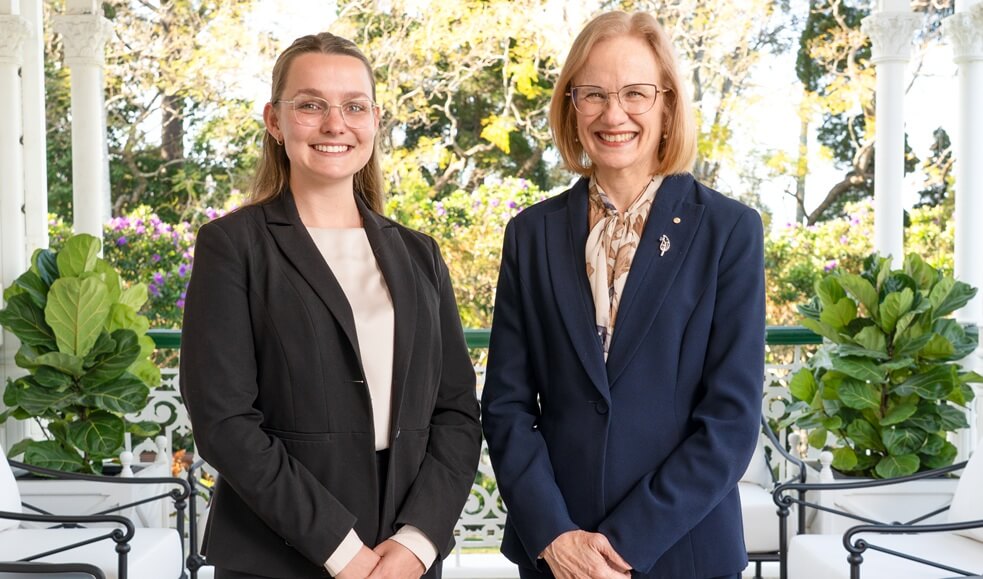
When Molly Swanson first approached the issue of the intersection between AI and the law, she had doubts whether she was the best person to be tackling the topic.
With no background in computer science, Molly thought she might be out of her depth trying to tackle one of the most talked about subjects in modern legal practice in her studies at Bond University.
But her interest in the impacts of legal, social, political and economic systems on individuals drove her to delve into the matter regardless – where she soon realised her background perfectly placed her to investigate how the two intertwine.
“The reason I thought I actually was the right person to look into it is because the solution we come up with for regulating AI needs to be accessible to all people, regardless of their educational background,” Molly explained.
“People who have no experience with AI and no technical understanding also need to be able to access these regulatory and transparency mechanisms for AI.
“Whatever legal mechanism we come up with to ensure transparency around these AI decisions, it needs to be understandable and accessible to people from all backgrounds.”

Her studies in this space led not only to the completion of a Bachelor of Laws and a Bachelor of Policy, Philosophy and Economics, but will now see her head to the UK as the most recent recipient of the Rhodes Scholarship.
Molly, who currently works as an Associate to a Supreme Court Judge, will use the opportunity to study AI transparency and human rights at the University of Oxford, within a Bachelor of Civil Law and a Master of Science in Social Science of the Internet.
She aims to use this experience to learn more about striking a balance between the issues and opportunities for AI in legal practice, something that has undoubtedly been a frequent topic across the profession of late.
From cautionary tales of over reliance to calls for more widespread uptake, it’s clear there have been multiple mixed messages around the use of AI by legal practitioners.
But that might not be the case for much longer.
Molly said it is likely more formal regulations will be introduced soon – but she doesn’t think that will be a bad thing.
“The discussion around regulation tends to be one that focuses on restriction, and how that’s going to restrict innovation but I’m very firmly of the belief that once we regulate and we set clear guidelines, that I think should champion human rights and focus on individuals, we’ll also see innovation increase,” she said.
“Because it gives faith to the broader public that AI is being used ethically and that they have the recourse mechanisms that they need.
“It also gives faith to the people developing and innovating AI that they’re not going to invest time, money and resources into developing technology that may be regulated out within a year or even sooner.”
Any regulatory action, Molly said, needs to address questions “around the use of data and privacy, and the risk of building discrimination into these models”.
“I also think that we forget that the autonomy is still on the humans using it and developing it ultimately,” she said.
“It’s being used, I think, for positive things, but there is also the risk of these negative implications that are just going to come with the territory and come with the advancement, which is why we need regulation.”
As Molly continues to build on her education and legal career, her advice to other young lawyers is not to be afraid to look at new ways of working.
“There’s a lot of dialogue around AI taking jobs and making the role of a lawyer obsolete but, at the end of the day, the law is a human practice and it’s always going to need people regardless of how AI is going to be used,” she said.
“I want to emphasize to young professionals that there is still a role for them in the law and to not be scared of AI, but to be critical of their use of it at the same time.
“As young people who have grown up with these technical advancements and, with AI already part of our lives, we’re really well placed to embrace AI and to navigate what its role in the legal profession will be.”






Share this article