




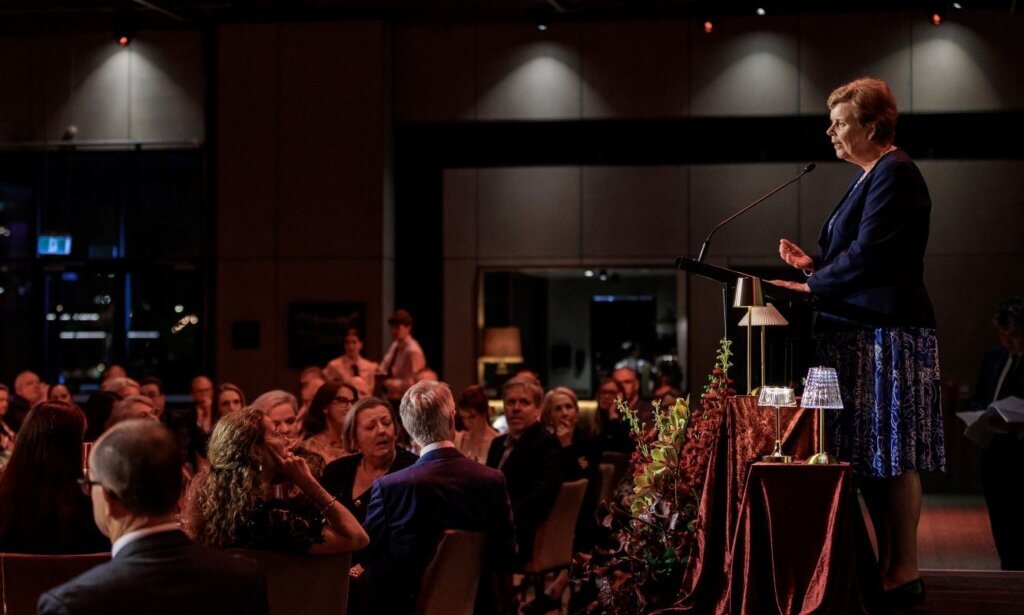
Self-represented litigants and artificial intelligence were two of the “serious topics” that the Honourable Justice Debra Mullins AO covered in her recent address to the 2026 Queensland Law Society President’s Dinner in Brisbane.
The President of the Court of Appeal joked with the 170-strong audience at the 20 February event that her brief was to speak for 10 minutes on serious subjects and she had chosen three with the intention of staying to time.
“The first is thanks to the solicitors of Queensland for their integral role in the administration of justice,” Her Honour said.
“The second is the burden for the Courts and the profession from self-represented litigants who present spurious arguments to the Courts.
“The third topic is the challenge we are all facing from the continually developing impact of artificial intelligence.
“When I preside at an admissions ceremony, I usually make a statement in these terms.
“The administration of the justice system in this state relies on legal practitioners so that it functions efficiently, fairly, and delivers access to justice, at least so far as resources permit.
“I mean that statement every time I say it.
“This is an occasion for acknowledging solicitors’ contribution to all aspects of the justice system in this regard.
“Thank you for advising clients appropriately when they have no prospects of success in litigation.
“Thank you for dealing professionally with your colleagues when your respective clients are at loggerheads.
“Thank you for your efficiency in dealing with probate applications and estates. That’s one area of the law where across the whole community, people are actually involved in the justice system whether they like it or not.
“Thank you for explaining to those charged with criminal offences of their options and the benefits that can flow from early guilty pleas if that was likely to be the outcome of the matter in any case.”
Her Honour said she was ticking off different areas of the law, “and I then had a really boring one in about contracts and transactions, so I thought I’d give an all embracing one”.
“Thank you for your independent perspective when acting for clients who find it difficult to untangle their emotional response to their legal issues from objective consideration of their rights and obligations whatever area of the law that you practice in,” she said.
“And my list could go on, but I will stop there.”
Her Honour also acknowledged the significant amount of pro-bono work that solicitors take on across all areas of the law.
“I’m married to a solicitor, and I know how much pro bono work he does,” she said.
“In respect of litigation, it is not infrequent for the Court of Appeal to have solicitors acting pro bono where their client cannot afford legal representation for the appeal after not succeeding at first instance and the firm feels very strongly about that client’s position.
“As President of the Court of Appeal, I am grateful for the participation of both barristers and solicitors in the Court of Appeal pro bono scheme for criminal appeals.
“I recently did a review with a prisoner whose matter wasn’t progressing, and it’s really important for criminal appeals to be disposed of, because often the complainants are waiting to see the outcome.
“And so I had this review and I asked this prisoner, would he be happy if I referred the matter to the Court of Appeal pro bono scheme? He said, ‘oh yes. They told me in the prison you’d get a lawyer for me.’
“So I get kudos from prisoners about that scheme, when the reality is the kudos goes to those barristers and firms of solicitors on the panels for the scheme who are willing to undertake criminal appeals pro bono where legal aid is not available.”
On a more serious topic, Her Honour said she understood when people appear for themselves because they could not afford a lawyer.
“The Court’s resources are strained when self-represented litigants find spurious arguments on the internet or are convinced by others to run spurious arguments that cause the litigation to expand unnecessarily and take up much more of a court’s time in reviews and hearings than the matter warrants,” she said.
“Some of you will have experienced that many times. If the other party is represented, the self-represented litigant will cause the other party to spend more on legal costs in responding to the spurious arguments than for properly conducted litigation.
“There are no easy solutions to dealing with this category of self-represented litigants.”
Her Honour said use of the Vexatious Proceedings Act to obtain a vexatious proceedings order seemed to have fallen out of favour.
“There are currently 25 persons on the list, which is on the Court’s webpage, and only three of them have been added since 2018,” she said.
“Those of you who practice in litigation will be aware of the usefulness of Rule 389A of the UCPR which allows a court in an existing proceeding to order that a party must not make a relevant application in relation to that proceeding without the leave of the Court, where that party has been prone to bring successive abuse of process applications in that proceeding.
“Because of the growth in this category of self-represented litigants, the Law Society may consider it is a matter for exploring other responses.”
Her Honour also touched on artificial intelligence.
“And we all know the impact of the capability of generative AI has been profound. I expect that many of your law firms have been at the forefront of exploiting the efficiencies that generative AI can bring to many tasks,” she said.
“If you’re interested, you may wish to look at one of the papers that’s on the High Court web page.
“It was given by Justice Michelle Gordon to a conference of judges last October on Justice in a Changing World – The Responsive Bench.
“It’s very aspirational for what judges must ensure we continue to do going forward into the future.
“But in the course of the paper, Justice Gordon explains how she uploaded the materials she identified in her research to a generative AI tool and asked for a summary guided by specific prompts and questions.
“It generated a clear and accurate summary in seconds – much quicker than a paralegal or a new graduate. AI drafted the abstract to the paper, which only needed slight amendments to reflect important nuances that Justice Gordon wanted to convey.
“The paper shows the abstract before Justice Gordon amended it, and after she amended it, there were not very many changes. It really illustrates what I know most law firms know about the power of generative AI.”
Her Honour said the Supreme Court Practice Direction 5 of 2025, dealing with accuracy of references and submissions, would be reviewed regularly.
“It’s already been reviewed once, and I’m sure it will be reviewed before the end of this year as well,” she said.
“The ethical obligations that presently apply to solicitors and barristers extend to the use of generative AI. To assist non-lawyers, the Court has published The Use of Generative Artificial Intelligence Guidelines for Responsible Use by Non-Lawyers, and that’s linked to Practice Direction 5 of 2025.
“The next issue for the Court and the profession is whether more specific guidance is required for the profession in the responsible use of generative AI. Watch this space.”

QLS President Peter Jolly also acknowledged the challenges for the profession in this space.
“Another ongoing challenge is that presented by the ever-increasing use of AI, particularly generative AI, and the pace of its evolution,” he said.
“We know the ways in which AI is being used by the profession, and self-represented litigants, is constantly being tested and expanded and we appreciate the work being done by the Courts to set clear boundaries for the profession and litigants as to its appropriate use.”






Share this article