




McCullough Robertson Pro Bono Partner Tim Longwill admits he has a really easy job, perhaps the easiest in the firm, as he doesn’t have to convince staff to become involved in pro-bono work.
This is a good thing as the firm, which began in western Queensland, is marking its centenary this year by making a $1 million commitment to provide pro-bono services to the housing sector.
“McCullough Robertson has been around for a long time, but this is our 100th year. You’ve probably heard about that,” Tim joked.
“Pro bono has been part of the way that we’ve done things for those 100 years, back to when Jock Robertson and Robert McCullough started the firm.
“They were instrumental in local communities and providing free legal advice to the local RSL and the local hospital, and I think that it’s grown from there.
“The thing that makes us stand out a little bit is that we have integrated the pro bono service within the firm.

“We were a founding law firm with LawRight, and we take that very seriously. We have designed a number of priority areas, those which align with what we do and how we do things.”
Those key areas are sustainability, access to justice, community arts, health, mental health, diversity and inclusion, and Indigenous communities.
Their efforts were recognised last year at the Queensland Law Society Excellence in Law Awards with McCullough Robertson winning the Pro Bono Team of the Year Award.
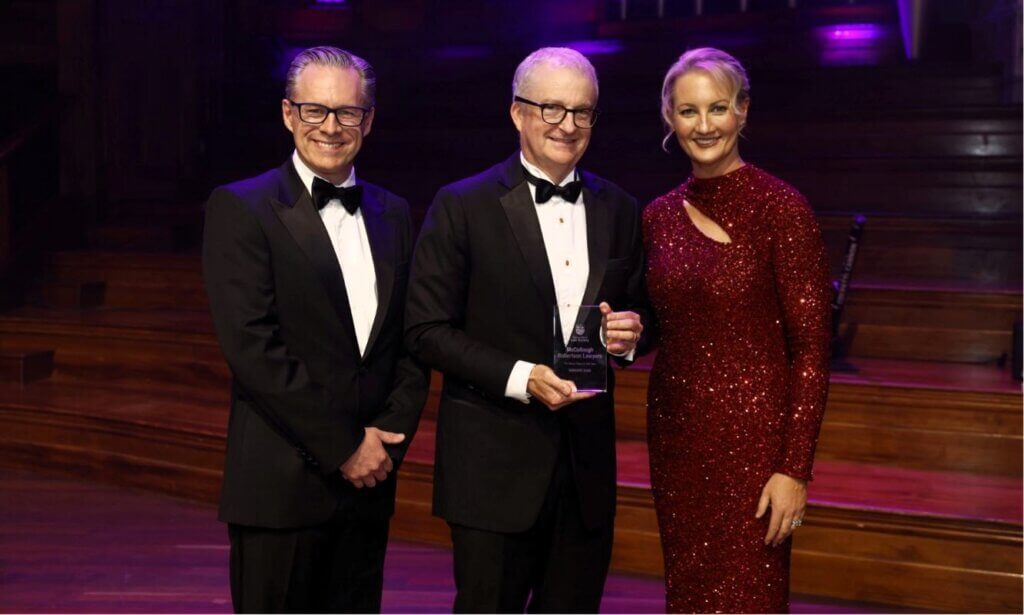
“I think the real success with McCullough Robertson and perhaps some part of the reason for the award is that we integrate the way we do pro bono within work,” he said.
“It’s indistinguishable from other work that we do in the firm, and I think that’s really important.
“It’s for a lawyer working on a pro bono file as opposed to a lawyer working on another client file, as I say, it’s exactly the same, the file management, the approach that is taken, and the professionalism with which it’s dealt is all exactly the same.
“And from their perspective, if they are oriented towards the bottom line, as most people within the profession are, it counts towards their bottom line as well, which is critical.
“And that’s the way that we properly integrated it.
“I guess the other thing I would say about it is that I’ve got the easiest job in the world because the people that we engage tend to be really keen on doing pro bono work. It’s just part of what they do.
“It’s channelling that energy, which seems to be my role, rather than trying to encourage people to do it.”
As Tim said in his acceptance speech at last year’s Excellence Awards, he believes helping others is part of a lawyer’s DNA and has seen that first hand, especially with early career lawyers.
“I used to be a grad partner, so I was responsible with a number of other of my partners for interviewing and engaging lawyers as graduates,” he recalled.
“And it was almost inevitable in any of those interviews, those graduates would be asking, or candidates would be asking, about pro bono and what we did by way of pro bono.
“So I’m not sure whether we attract those sort of people or whether that’s just the way people are at the moment.
“But I had this fantastic statistic within the firm that last year, 85 per cent of the lawyers involved in the firm had done pro bono work.”
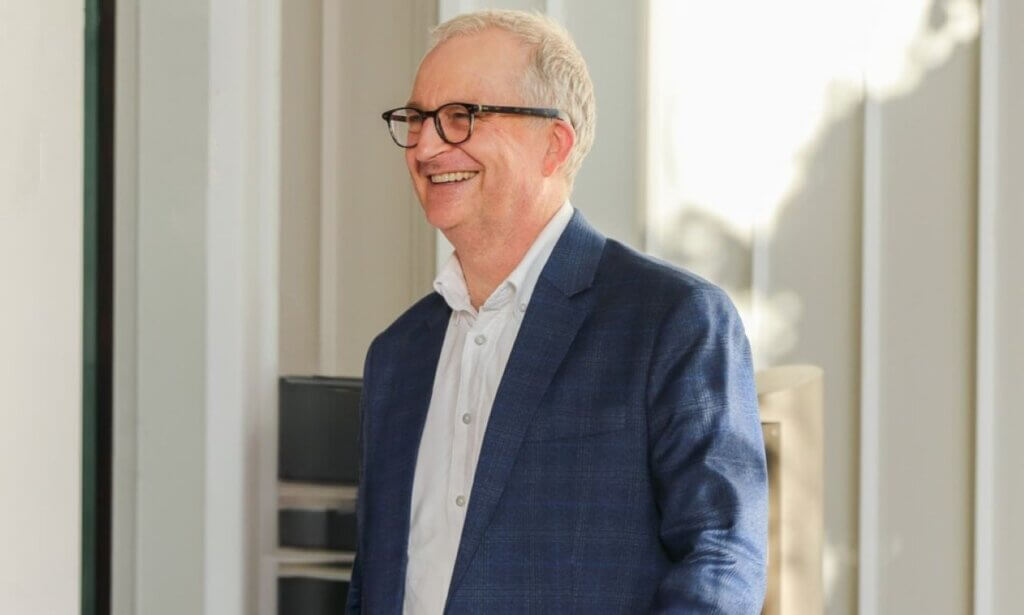
Tim said a peer involved in community legal service was “astonished” by that figure when he shared it recently.
“My job really is just funnelling that energy into the appropriate areas of need from a pro bono perspective. So I’ve got a really easy job in that respect.”
The opportunity to do pro-bono work is not limited to lawyers in those priority practice areas.
“We do a lot of clinic work with LawRight and more recently, we are starting a partnership with Caxton, where lawyers who don’t necessarily do work that lends itself to doing pro bono as file work, can go along and participate at clinics,” Tim said.
New staff can bring pro-bono with them and the firm is expanding staff involvement.
“People come into the firm wanting to do it and are enthusiastic about it. And the fact that we do have it integrated as part of the life of McCullough Robertson makes it easy for them to do that,” he said.
“It’s just the same as any other file work. And they also have the opportunity to bring pro bono work into the firm, as they will be involved in local communities or involved in local organisations, social organisations, health organisations, and they will want to be able to assist and they can.
“They can come along and say, ‘Look, I’d like this constitution reviewed’, and it just goes straight into to the file load, and it gets dealt with in the same way as any other file.
“I’m particularly lucky because it’s the people that work in the firm are just enthusiastic about it and nothing is too much trouble in terms of what they want to do. And I’m always being approached not just by the lawyers, but other people within the firm who want to be involved in providing pro-bono services.
“And we do that, make that available to anybody within the firm, not just lawyers. We’re looking at ways to explore, to give other legal assistance and our terrific admin staff the opportunity to do that. We’ll continue to do that.”
Part of the success of the firm’s pro-bono role is forming crucial, ongoing partnerships.
“We form community partnerships. People can actually be involved in the work that our community partners do, whether that be Rosie’s, for example, or whether it be Queensland Ballet,” he said.
“We’ve got such a close connection with the organisations for whom we act. And I think last year it was about 116 different social and health organisations, charities and other non-profits, that they get the opportunity to experience that firsthand.
“So not only do they get the opportunity to help out, but also to experience that. And we’re also involved in, through that program, in things like Darkness to Daylight and LawRight, the Legal Walk, those sorts of community events that people can be involved with and want to be involved, be proud of what they do.
“So that’s part of the package as well, is that we encourage that sort of participation. And that also finds itself in things like people becoming members of boards. We’ve got people on La Boite, for example. We’ve got people who are with the RSPCA.”
One current project the firm is focused on is a large community housing project in Cairns – $500 million worth of development.
“What it does is provides almost 500 dwellings for seniors and those with disability. So it’s sharply focused on providing accommodation housing for people who are vulnerable,” Tim said.
“And that’s really a focus from our perspective, so much so that we’ve done quite a lot of social housing, community-based housing. It seemed an obvious problem that Australian society is facing at the moment.
“But it also has other aspects to it that we can address, such as mental health conditions. It’s really quite hard to address mental health when you’re fighting for housing. So, it has not just the problem of accommodation, but also these ancillary problems that flow with that.
“And we thought about that with the 100 years. We thought about the sort of legacy that we could leave after the 100 or during the 100-year celebration.
“We didn’t want bronze statues and naming rights in buildings and whatnot. So what we’ve decided to do is to devote $1,000,000 worth of pro bono legal services towards community housing projects.
“And we started that in January and I think we’re well on the way to achieving that.
“It’s a drop in the ocean in terms of the amount of money and resources that might be needed to address the problem wholly, but we think that it’s probably, hopefully, enough to make a semblance of a difference. And that’s the sort of legacy that we wanted to leave in our centennial year.”
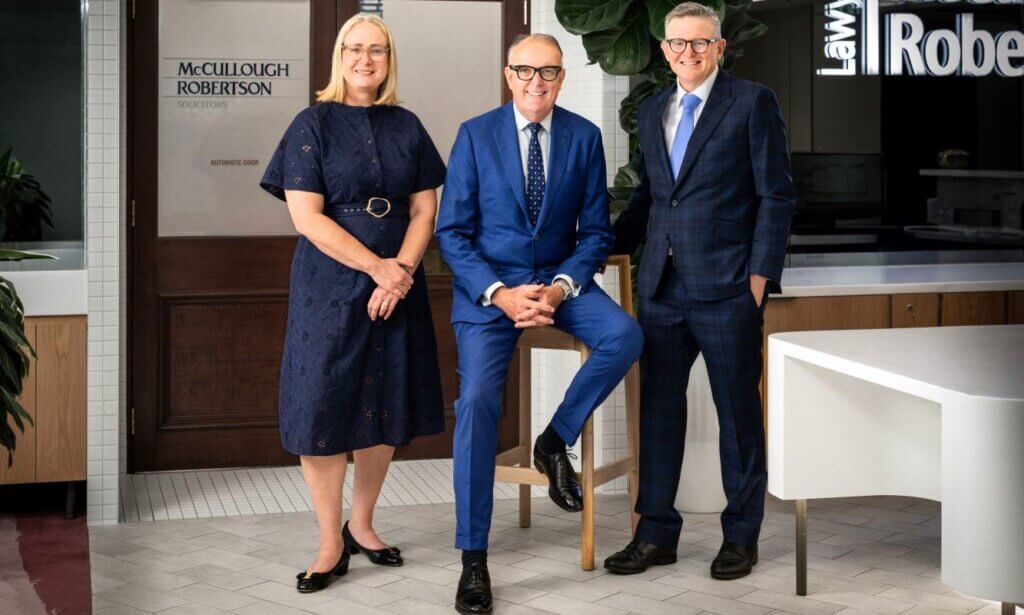
McCullough Robertson Chair of Partners Kristan Conlon said the firm was committed to preserve the essence of McCullough Robertson and to leave a legacy of community contribution.
“As a firm, we believe everyone deserves and needs a home,” Ms Conlon said.
“This builds on the pro-bono advisory support provided to the sector during recent years through our Community Partnership Program.
“As our firm turns 100 we are looking to work with government, industry leaders and housing providers to design and deliver practical and much-needed step change solutions.”
So how did Tim, the Employment Relations Partner and Aged Care Specialist, end up getting the easiest job in the firm?
“I think there was a realisation, pretty much organic realisation, that we needed to be not only doing it, integrating into the work that we do, but to be seen to be integrating into the work we do, treating it seriously,” he said.
“I do a lot of work in the non-profit space in the health and aged care space and but also non-profits generally. And because we do a lot of work in the pro bono space for those non-profit organisations, it was easy for me to do it.
“And with Kim’s (Trajer – Chief Operating Officer) guidance and assistance, which is ongoing thankfully, we’re able together to have the program going and functioning and exploring different avenues like the Caxton and other things that come up.
“The other thing that we do now that we haven’t done before is we have secondments.
“So there are other opportunities that have grown out. We’re always looking for things that we can do to satisfy this desire to give back. And as I keep saying, it seems to be more, from my perspective, channelling that energy into areas of need than it is having to encourage people to do it.”
And Tim is sustaining his energy thanks to the passionate people in the pro-bono sphere and the work they do.
“I’m kind of at the latter end of my career and this has been a real joy for me, doing something which is perhaps marginally more meaningful than the work that I was previously doing. No disrespect to the work that or the clients that I previously and I continue to work for,” he said.
“I have a full load and I’m the team leader in the Brisbane office of the Workplace Relations Group, so I’ve got plenty to do. But I can genuinely say the pro bono clients for whom I do work and the interactions that I have with our community partners is always pleasant.
“It’s just good working with passionate people and you don’t work in the space unless you have some passion for it. Sometimes I find it hard to keep up to be honest but that’s nice.
“And a lot of what these organisations that we do work for, the non-profit organisations, are doing really important work. These people are always very enthusiastic and passionate and helpful and understanding. It’s just a great environment to be in.”




Share this article