



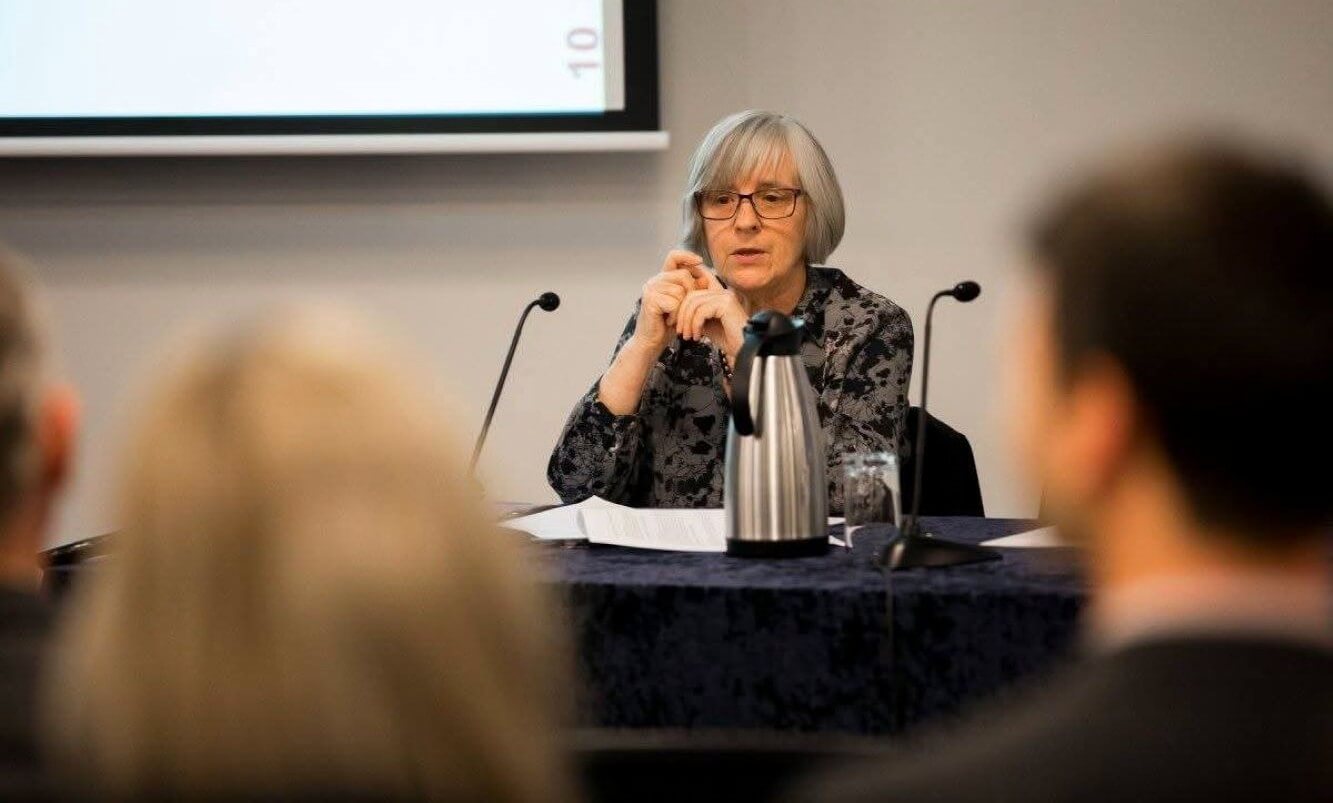
More than three decades ago, linguist Dr Diana Eades published Aboriginal English and the Law: A Handbook for Legal Practitioners, an important resource commissioned by the Queensland Law Society.
At the time, the handbook filled a critical gap and illuminated how misunderstandings of Aboriginal English, the first language of many Aboriginal people, could profoundly affect legal processes and outcomes.
Thirty‑four years later, the relevance of her work has not faded.
When I first started at QLS in 2022, our CEO, Matt Dunn, then serving as Legal Policy Manager, handed me a copy of the handbook. He remarked on how valuable and relevant it still is today, more than 30 years after publication. He was right.
Recently, a Victorian barrister contacted me requesting a copy of Dr Eades’ book, which led to my curiosity of its relevance.
Despite shifts in legal practice and significant growth in cultural competency frameworks, practitioners, judges, and advocates still seek practical guidance for communicating effectively and ethically.

Why it remains a foundational resource
Dr Eades’ work remains foundational because it made clear that Aboriginal English is a legitimate, rule governed dialect, not broken English. Misunderstanding it can lead to miscommunication in interviews, inaccurate credibility assessments, unreliable admissions, unfair cross examination, and even miscarriages of justice. Her research provided the legal profession with the language, framework, and evidence needed to recognise these differences.
Despite improvements in cultural competency, the legal system still often treats all forms of English as the same. This leads to ongoing linguistic bias, where Aboriginal witnesses and defendants can be misunderstood or judged unfairly.
As justice conversations evolve, there is renewed recognition that understanding Aboriginal English is central to fairness. New generations of lawyers, especially those working with First Nations clients, are learning meaningful justice requires genuine awareness of linguistic nuance and the cultural contexts in which communication occurs.
This was highlighted recently in ASIC v Select AFSL (2022 FCA), where the Federal Court accepted gratuitous concurrence as a real communicative phenomenon. The decision set an important precedent and echoes the concerns Dr Eades first raised more than three decades ago.
To explore why this work continues to resonate across decades, I spoke with Dr Eades to reflect on the origins of the book, her years of research, and her hopes for the future.
What first inspired you to write Aboriginal English and the Law more than 30 years ago?
The turning point for me was working on R v Condren. Kelvin Condren had been convicted of murder, and I was asked to analyse the answers attributed to him in the police interview. It became immediately clear that the police record could not have been a verbatim account of what he actually said. This was before interviews were audio recorded.
What pushed me to write the handbook was the appeal judges’ reasoning for ruling my evidence inadmissible. Their comments reflected the belief that a person’s dialect could be explained by biological characteristics such as skin colour or “fraction of Aboriginal descent.” It also showed that some judicial officers had little understanding of Aboriginal culture or the legitimacy of linguistics as a specialised field.
At the same time, lawyers I spoke with, particularly those working in Aboriginal Legal Services, told me that the other issue I was studying about communication style was central to their daily work. All of this made it clear that the legal profession needed practical, accessible guidance.
What did you learn from your early ethnographic work in South-East Queensland?
Those years were extraordinary. When I moved to Brisbane, I made it known that I was available to work with any Aboriginal group who wanted help documenting their language. That led me to Gooreng Gooreng and Wakka Wakka families, and they were incredibly generous, allowing me to spend time with them, observe daily life, and record ordinary conversations.
The big thing I learned was the strength of Aboriginal culture and communication practices, even when people’s everyday lives looked superficially similar to mainstream Australian life. People mostly used English, but they were using it in ways that did not align with mainstream norms. It sounded like English, but it worked differently.
I realised that while linguists at the time understood accents and vocabulary differences, we did not yet understand the pragmatics, the cultural norms governing when to speak, when to hold silence, how to show respect, and how to seek information. Indirect answers, silence, avoidance of direct questioning, and agreeable responses all made sense once I understood the cultural context. These lessons shaped all my later work.
Why does the legal profession continue to turn to your work?
Many legal professionals, especially those who started their careers in Aboriginal Legal Services, have long understood that the law often communicates poorly with Aboriginal people. Even with overwhelming workloads, those lawyers are deeply committed to finding better ways of communicating.
Across decades, I have seen lightbulb moments in workshops where lawyers say, “Yes, I have seen exactly that in my clients.” The foundational issues I wrote about, such as gratuitous concurrence, silence, and mismatched assumptions about questioning, are still present today.
At the same time, there is important work to be done on how Aboriginal English and communication are changing. This includes the newer languages of Indigenous young people, which are evolving all the time. I am very much looking forward to Aboriginal and Torres Strait Islander linguists leading this work and exploring what these changes mean for communication in legal processes.
Are there particular practices in courts or policing that still create barriers for Aboriginal speakers?
Yes, absolutely. One major issue is the system’s reliance on interviews. Legal and institutional processes often assume that asking many direct questions is the best way to obtain information and stories.
For many Aboriginal people, direct questioning can be inappropriate, rude, or simply ineffective. Patterns I identified decades ago, such as gratuitous concurrence or silence, are still very relevant. The law’s reliance on interviews not only makes it hard for some Aboriginal people to tell their stories, it can also make it hard for the legal system to hear what is being said.
This approach can be challenging for many lay people, but there are cultural reasons that can make it particularly difficult for Aboriginal people. When the system relies so heavily on direct questioning, it restricts the way Aboriginal people can communicate, and as a result it can prevent the law from understanding their experiences and perspectives. These issues remain particularly relevant for Aboriginal people in remote areas who may not have had opportunities to develop strong bicultural abilities.
It is important to say that in the decades since the handbook was written, the number of Aboriginal people who are bicultural has grown significantly. That is, many more Aboriginal people now can switch between communicating in an Aboriginal way in Aboriginal interactions, and in a mainstream way in non-Aboriginal interactions. So, in institutional settings like the law these bicultural people are not likely to communicate in the ways outlined in the handbook.
Also, when writing about bicultural people in 1992, I used the term “bicultural competence”, drawing on the way that linguistics and anthropology at that time used the term “competence” in a technical sense (it’s not only lawyers who take ordinary English words and use them in a slightly different way!). In recent decades I have moved to the ordinary English term “bicultural ability”, which does not have the negative connotation of the earlier term.
How has your thinking evolved as new research and social contexts have emerged?
Over time, I came to understand that simply educating legal professionals about cultural differences in communication is only one part of what needs to happen. Change also requires looking closely at the structures of the legal system itself. The more I learned about legal processes, the more convinced I have become of the need for systemwide reform. Reports like Closing the Gap continue to highlight the overrepresentation of Aboriginal and Torres Strait Islander people in the criminal justice system, more than 30 years after the Royal Commission into Aboriginal Deaths in Custody, which makes it clear that the deeper issues have not been addressed.
I also came to see the legal system as a structure of neocolonialism. The Pinkenba case in the early 1990s made this very clear. The cross-examination of the Aboriginal three teenage boys in the Brisbane Magistrates Court revealed how the accepted processes in our legal system allowed questioning that resulted in legitimising police removal of Aboriginal children from the street, and abandoning them out of town. (This serious claim is explained in my analysis in the 2008 book Courtroom Talk and Neocolonial Control).
But, there have been positive developments. The growth of Indigenous Sentencing Courts, such as the Murri Courts, should not be underestimated. These courts can incorporate Aboriginal ways of communicating because they are not bound by the rules of evidence in the same way. Importantly, they recognise and rely on the expertise and authority of Aboriginal Elders and respected persons. As NSW Aboriginal magistrate Mark Douglass has said, offenders are less likely to reject the process as a top down creation of colonisation and are more likely to participate meaningfully.
Another thing that changed in my thinking and understanding was my early view that the legal right to an interpreter should be extended to the provision of “cross-cultural interpreters” for speakers of Aboriginal English (Handbook pp81-2, 88). Within a few years of making this claim, I had come to realise, after discussions with judicial officers and lawyers, that this would be unrealistic, and might also lead to ridicule of Aboriginal English. Further, rephrasing what a person has said (or not said) when cultural issues in communication are present (such as silence or gratuitous concurrence) can never properly be the role of an interpreter. This point takes me back to why the Indigenous Sentencing Courts are so important: they provide space for Aboriginal people to think and speak, with less dependence on the Anglo interview method and the strict constraints within that of the rules of evidence.
What gives you hope about the next generation?
I feel hopeful when I see more Aboriginal and Torres Strait Islander people entering linguistics, especially those who are studying how Aboriginal English and the related Creoles continue to evolve across generations. These languages are not static. Aboriginal English today is different from what it was 30 years ago, and Creoles are also changing as young people shape their own ways of speaking. This is why it is so important for First Nations linguists to lead this work. They bring cultural knowledge, lived experience, and an insider understanding of how language continues to shift in their communities.
I am also incredibly encouraged by the strength and expertise of Indigenous legal professionals, such as magistrates, judges, barristers, and advocates. Their lived experience and cultural knowledge bring something invaluable into the justice system. I look forward to the day when an Indigenous judge is appointed to the High Court. I hope I see it in my lifetime.
Who are prominent solicitors or mob who have had a big impact on your work?
Several people have influenced me at different stages. When I was working on the handbook, Sue Sheppard and Rob Hulls, both Queensland solicitors at that time, were encouraging and supportive. Their guidance helped me shape the work in ways that made it more useful for legal practitioners.
In more recent years, I have worked with Josh Creamer, a barrister who has been a strong supporter of my work and someone I deeply respect. There are many others, but those three in particular stand out to me.






Share this article