


How does a person end up on an internship on the other side of the world in a completely different legal sphere?
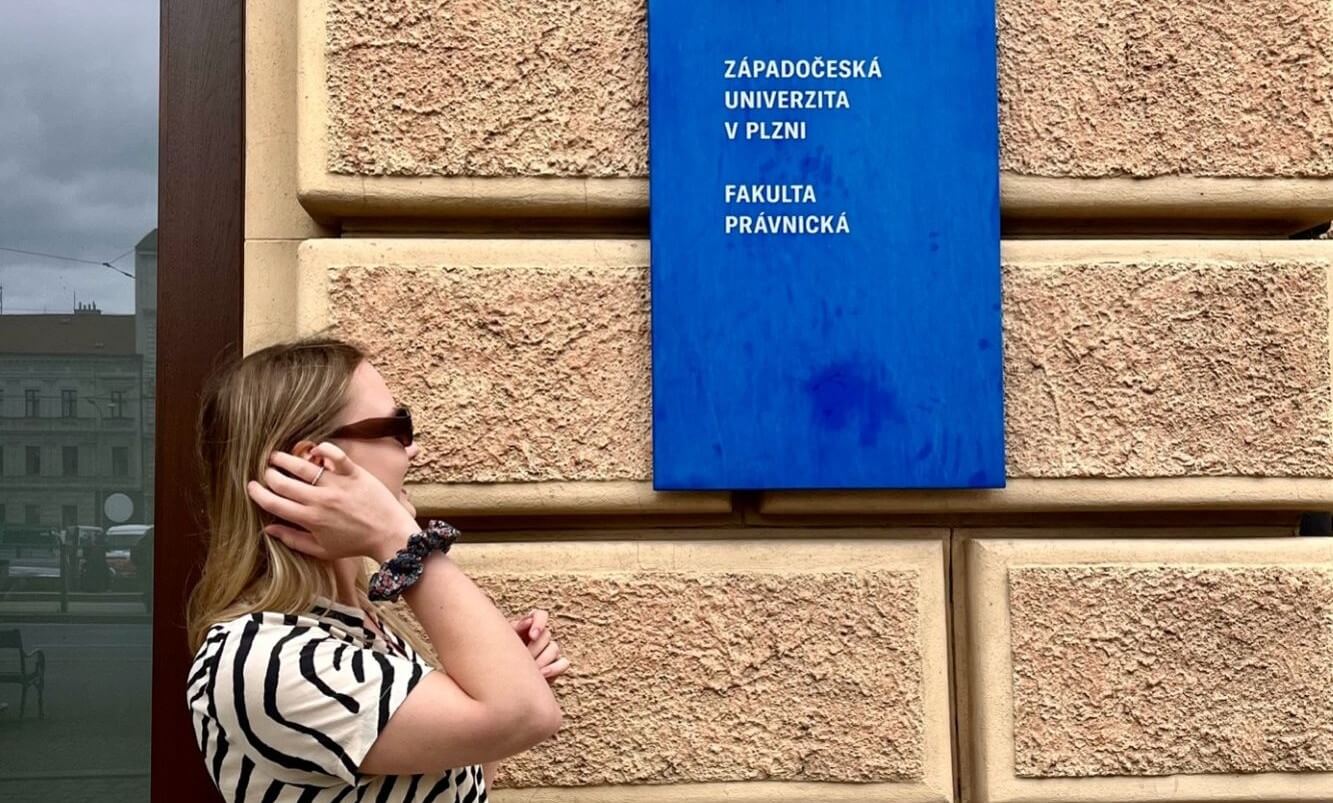
I am Lucie Budáková, a law student at the University of West Bohemia in Pilsen in the Czech Republic. Over the past two months I have been spending time at a law firm in Brisbane which has provided me with opportunities to gain insights into the Australian legal system by observing and experiencing day-to-day office work and court hearings, in a major Australian city.
The idea of coming to do an internship in Australia occurred to me when I enrolled in a subject called Legal English at my university. The subject was focused on cases from the United Kingdom. I was fascinated by the differences in the Anglo-Saxon legal culture compared to how it is done in the Czech Republic. Moreover, I was intrigued by the opportunity to gain experience in a legal practice abroad.
Like most European countries, the Czech Republic is part of the civil law tradition. We do not use precedents in the same way as Australia, and we do not have a jury – although we used to in the past. The courts in the Czech Republic consider each case individually and their decisions sometimes elaborate on a situation or concept that may not be immediately apparent from the wording of the law. However, while these decisions do not create strictly binding precedents in future cases, they serve as persuasive guidance to ensure consistency and predictability in future court rulings.
It is important to mention how one becomes a lawyer in the Czech Republic. You must complete a specific five-year master’s program in law, which is offered at only four universities nationwide. Graduates choose what area of law they want to practise and which legal profession they want to pursue.
A major difference is the split between barristers and solicitors. In the Czech Republic, the legal profession is unified. To become a fully qualified advocate, besides the law degree, one must register with the Czech Bar Association and then complete a three-year legal clerkship – the entire process culminates in the bar exam. Advocates in the Czech Republic are not required to work independently, as barristers do here, although they may choose to do so. An advocate is someone who most often works in a firm performing duties such as client management and court appearances in a role that merges Australian lawyer and barrister responsibilities.
Judges play a major role in our country’s legal system. Like Australia, we have courts at several levels, as well as one special judicial body, the Constitutional Court, which stands apart from the traditional courts and functions as a safeguard for democracy. To become a judge, one must complete the integrated five-year master’s degree and then gain three years of practical experience, followed by judicial examinations. In addition, candidates must meet an age requirement – 30 years for ordinary court, but as high as 40 years for the Constitutional Court. Judges make decisions both individually, as sole judges, or in panels of judges.
You do not realise the differences until you are putting them into practice. I used to assume that while statutory texts vary across borders, the core process of applying the law would be fairly similar everywhere. Upon arriving here, I quickly realised how wrong I was.
I learned that an explanatory memorandum is issued for each new law, which explains in detail what the text of the law actually means. In contrary, Czech statutes feature an official Explanatory Report, which only provides a foundational overview, and Czech practitioners heavily rely on legal commentaries to interpret specific provisions.
Authored by leading judges, academics, and senior advocates, these commentaries serve as authoritative secondary sources that explain how the statutory text is applied in daily practice. This difference is quite evident in the preparation of legal research reports, which are part of my practice here. In Australia, the result is most often the identification of a precedent – or even several precedents – that apply to the issues at hand, and the approach to handling the client’s case is then based on those precedents. Back home, I would look for court decisions, as well as commentaries and scholarly articles in addition to those decisions.
The main point of difference in an Australian courtroom is the presence of a jury. Although I was familiar with the concept of juries, in practice I found it quite surprising. I originally thought the jury functioned as a support, whereas in reality, a court outcome is largely determined by the jury. In the Czech Republic, a jury system existed until 1949, however, today I would gather that the general population would view a jury system in a rather negative way. At first, I was not fond of the concept of a jury either; it did not make much sense to me how someone without a legal education could decide on something so serious, but after my experience in Australian courtrooms, I understand the purpose and advantages a jury system can offer.
I have already attended several court proceedings, but the case that stands out most in my memory is one from the very beginning of my internship, because it was the first time I got to see a jury in person – and after two long days, the jury was discharged because they could not reach a verdict.
As soon as I entered the courthouse, I was struck by the architecture. Our courthouses are usually located in older buildings that, while they have character, often show their age. The courthouse here in Brisbane is modern; everything is new. One thing, however, remains the same – the security check at the entrance.
At 10am, as I entered the courtroom, I bowed to the bench, which the Director of the law firm where I am interning pointed out to me. We do not have any tradition of bowing to the bench in our country, so this surprised me.

The second thing that caught my attention was the wigs – they are not worn in our country. On the other hand, robes are worn at home by advocates, judges, and even prosecutors. After his opening remarks, the judge sent us out into the hallway, where – by my estimate – about 50 people were already waiting; they then entered the courtroom. The final jury for this particular case was being selected, a process which took about an hour. We were finally able to return to the courtroom, where 12 jurors were already waiting; all the evidence was presented, and the witness examinations began. The entire trial lasted two days. This was a truly fascinating moment.
In addition to the Supreme Court and the District Court, I also visited the Magistrates Court.
My experiences in court, as well as my day-to-day work – where I was able to be involved in cases involving immigration law, meetings with clients, and spending free time with my colleagues – are memories I will take home with me. I gained great insight into a completely different legal world, which was my goal, and it was achieved 100 per cent – all at a wonderful law firm to which I will be forever grateful for this opportunity.
Beyond this theoretical aspect, the entire experience has certainly given me a better grasp of legal texts written in English and improved my legal English overall.
However, I would also like to be an inspiration to others, because I believe that in today’s globally interconnected world, gaining international experience is a great thing to have – you never know when and where our legal worlds might intersect.







Share this article