



The law has always had its own way of speaking, shaped by long‑standing traditions and habits. Latin terms sit beside phrases many new lawyers barely recognise, while modern slang and even emojis now appear in day‑to‑day communication.
With so many styles blending, it’s no surprise that judges, partners and junior lawyers can all stumble over a single unfamiliar word.
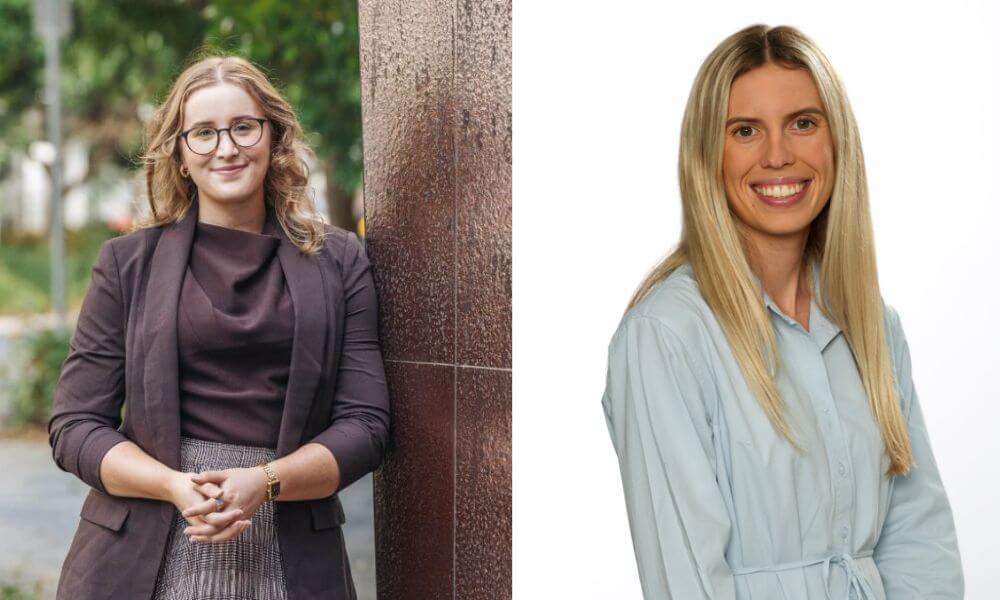
For two young Queensland lawyers from Travis Schultz & Partners, Georgia Coen and Shelby Bennett, this problem became obvious during a dinner late last year.
A senior colleague used a phrase that was completely innocent in his generation – but in Gen Z slang, it meant something quite different.
“We just froze,” Ms Coen said. “To us, it meant something completely different.”
That moment of made them realise something important: a profession that relies on precise language no longer shares one common way of speaking.

At this year’s Queensland Law Society Symposium, they’ll explore what happens when legal communication spans multiple generations.
Even the High Court isn’t immune
Their research uncovered linguistic blind spots at the highest levels of the judiciary. In one High Court exchange they found, former Justice Michael Kirby, known for his eloquence, paused mid‑analysis to ask what the word “hammered” meant.
“To young people it’s obvious, it means really intoxicated,” Ms Bennett said. “To Justice Kirby, it was completely mystifying.”
The moment was brief, but it showed that even the most brilliant legal minds can be tripped up by changing language.
When ‘slay’ meets silk
In their own workplaces, these mismatches appear daily.
Ms Bennett often drops a “slay” in an email to her supervising solicitor. His response is usually polite bewilderment.
“He’ll say, ‘I have absolutely no idea what that means,’” she laughed.
Ms Coen has accidentally become the “emoji translator” for older colleagues.
“People ask, ‘Does the peach emoji literally mean fruit?’ And I have to decide whether to explain… the other meaning.”
Technology adds more challenges. One partner once asked how to add “those moving pictures” to an email.
“He meant GIFs,” Ms Bennett said.
These moments are funny, but they also show how miscommunication can affect workplace relationships, client interactions and even courtrooms.
A generational shift reshaping the legal soundscape
Part of the story is demographic. Queensland’s legal profession is younger than ever, with more than 60 per cent of practitioners under 45. That naturally changes the everyday language of the job.
“Young lawyers today are more confident bringing their whole selves to work,” Ms Bennett said. “And language is part of that.”
Ms Coen added that social media has accelerated this shift.
“We’re exposed to how our peers speak all day long. It’s natural that some of that slips into our professional communication.”
But nothing lasts forever. As Ms Coen noted: “One day we’ll be the ones confused by whatever Gen Alpha is saying.”
Already, their younger relatives are leaving them behind. “Someone asked me what ‘skibidi toilet’ meant,” she said. “I had to consult my young cousin.”
Building bridges, not flattening differences
Their message isn’t that everyone should suddenly talk like Gen Z — or that young people should drop their own language. Instead, they encourage awareness.
“Know who you’re talking to,” Ms Bennett said. “Adjust your language when you need to.”
Ms Coen added: “Language should connect people, not divide them. The law must reflect the people it serves — and that means adapting.”
Their Symposium session will focus on finding the right balance between clarity, tradition and change.
From study partners to linguistic diplomats
Ms Coen and Ms Bennett have been friends since university, bonding over long study nights and assignments.
Ms Coen calls herself the “fluffy writer,” while Ms Bennett is “the researcher”. Together, they make a formidable team.
“We’ve had so much fun working on this,” Ms Coen said. “We talk about it after work, at dinner, and after weird emoji moments.”
Ms Bennett laughed. “In 50 years, we’ll be the confused ones — and we’ll absolutely deserve it.”
For now, they’re the legal profession’s most enthusiastic translators, helping older lawyers understand memes and helping younger lawyers understand traditional idioms.
And who knows — by next year, “slay” might be as outdated as “hammered”.
You can hear more from them at Symposium 2026 in Brisbane on 13 March.





Share this article