



Former Ashurst Partner and successful crime writer Joanna Jenkins has launched her third book calling on the same discipline she once brought to legal contracts.
Joanna spoke about the process behind her writing at the Bad Neighbours Lunch with “fellow recovering lawyer” Eddie Scuderi of Corrs Chambers Westgarth, in front of a room full of legal professionals in Brisbane last week.
The author of How to Kill A Client and The Bluff recalled for the audience the moment that crime fiction solved a problem for her.
It was three o’clock in the morning, she was lying awake and running through all the things she could have done wrong with the stressful and enormous files waiting for her at work. One particular person was giving her “a bit of grief” and then the solution arrived with startling clarity.
“I sat up in bed and said ‘I’ll kill one of them,’” Joanna said to much laughter.
“And it was so great. I strongly recommend it. It made all of the difficulties with any of the clients go away.
“So you just look at them and think, you’re not going to survive the night.”
And with that early-morning revelation, the former big law solicitor found the premise that would eventually become her debut novel, How to Kill a Client. Her third novel, Bad Neighbours is another mystery featuring lawyer Ruth Dawson, but this time is set in Sydney rather than Brisbane.
Before fiction became her full-time job, Joanna spent years focusing on words of a different kind with contracts, clauses and file notes.
She said writing novels was not entirely different.
“I drafted contracts for a long time,” she said. “Actually, in many ways, it’s not that different, except you have to make it up.”
That, she discovered, was the hard part. In law, the facts arrive on the desk. In fiction, the writer has to invent the facts, the people, the lies, the motive and the death then make them all work across tens of thousands of words.
“And when you’re being a lawyer, you are presented with the facts and you’re trying to find a solution, you’re trying to negotiate a contract, whatever it might be,” she said.
“But in writing a book like Bad Neighbours, you’re less constrained.
“It’s actually a bit like a puzzle and putting together a puzzle and making sure that it all works together.”
Even so, Joanna said the desire to write had been there from a young age.
“I always thought I had it in me,” she said. “That’s what I wanted to be when I grew up.”

Joanna entered the Vogel’s Literary Awards, a competition for unpublished manuscripts by writers under 35, and didn’t win. However, she was not deterred and kept persisting and looking for a publisher.
She does not regret the career change and definitely does not miss recording her life in six-minute increments, but Joanna does recognise the skills that legal practice gave her: the ability to keep going when the work is difficult and attention to detail.
“It requires discipline,” she said of writing. “The capacity to sit there because sometimes it’s actually quite lonely.
“At least in a law firm, well, not so much now because they’re working from home, but at least there’s kind of a bustle around you and there are people you can talk to.
“So it is quite lonely because you’re sitting there just kind of pulling it out of the air.
“But the discipline of sitting in front of a keyboard and a computer and making yourself fight through the inclination to go make yourself a cup of tea. That is actually a discipline that I got from being a lawyer.”
For Joanna, the crime writing begins less with the murder than with the people. She starts with characters, then lets them “rub up against one another” until the pressure of the setting begins to produce a story.
Crime fiction has its forms – police procedurals ad investigations that begin with a body and work backwards through motive and opportunity – but Joanna is drawn to the way a plot can expose the relationships inside a closed world.
“Really, it’s kind of an examination of a particular setting and the characters in the setting,” she said.
The challenge is coherence: an 80,000 or 90,000-word manuscript must hold all the puzzle pieces together. Every action has to feel plausible. Every secret has to be placed carefully enough to be fair, but not so obvious that the reader solves the case early in the book.
Joanna did not learn how to write by doing a writing course. “I couldn’t do another degree,” she said.
“So I thought, how hard can it be? I’ll teach myself.”
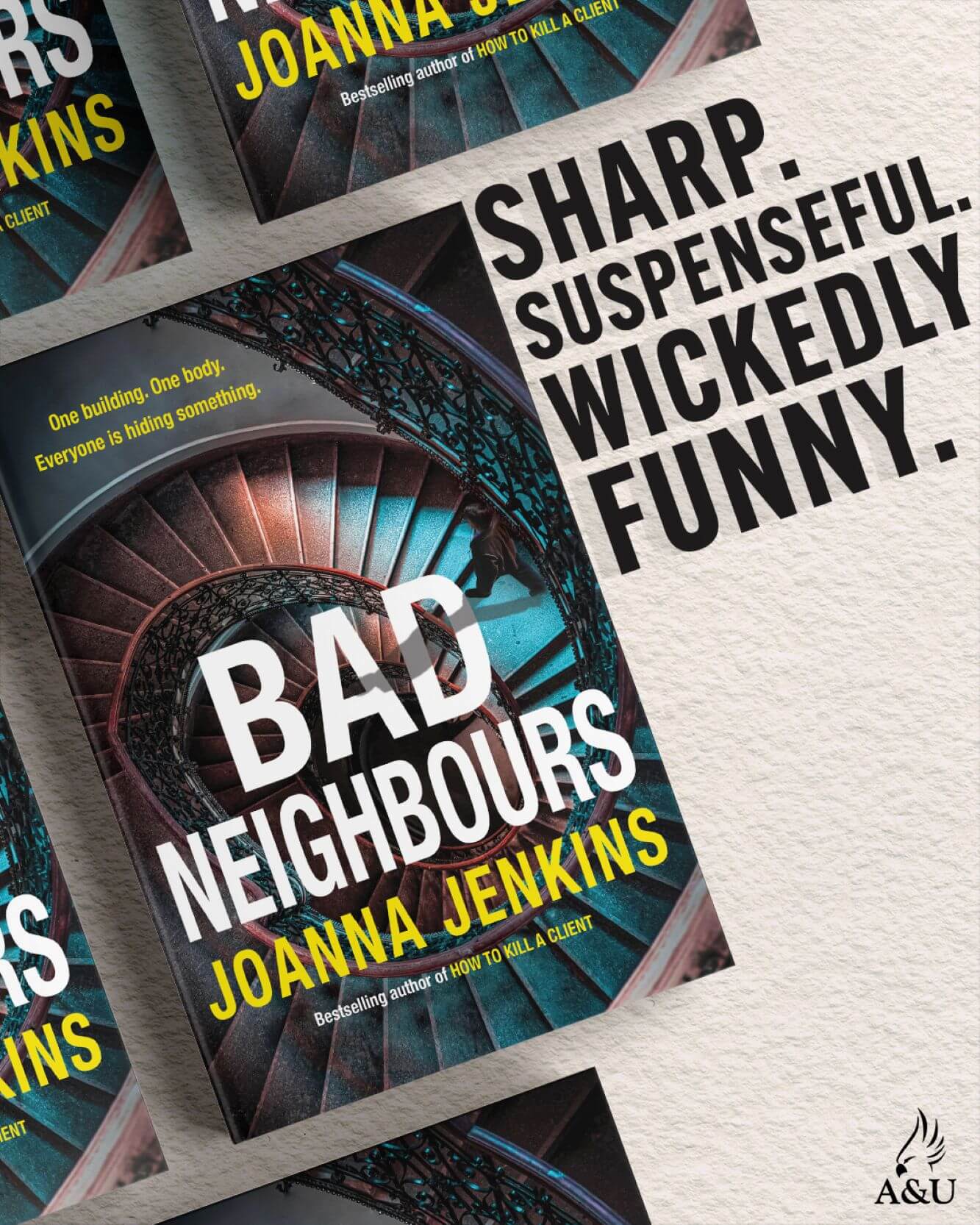
Much of that education came from reading, rewriting and editors who produce an editorial report. The unexpected report on How to Kill a Client, her first novel, ran to about 30 pages.
It began, she recalled, with two paragraphs of praise.
Then came “29-and-a half pages of withering criticism” including the devastating observation that it was obvious who the murderer was from page three. (Although the report did finish with a paragraph, saying it was a great book.)
Her solution was practical: change the perpetrator to make sure it was less obvious.
“I’ve actually done that in all three books,” she said, laughing at the recurrence of the same editorial problem.
And when it came to working out how to kill off characters without being detected in the book, Joanna approached a medical practitioner. Their advice was to google it.
“ChatGPT came back with all of these scenarios,” she said. “You know how it’s very enthusiastic and it wants to help. So I do a lot of googling.”
And there is googling currently taking place with Ms Jenkins working on her next book.
The book launch, hosted by Lacuna Professional Solutions, also doubled as a fundraiser for Four Voices, a free connection and support service for women, experiencing hardship or challenges including homelessness.






Share this article