



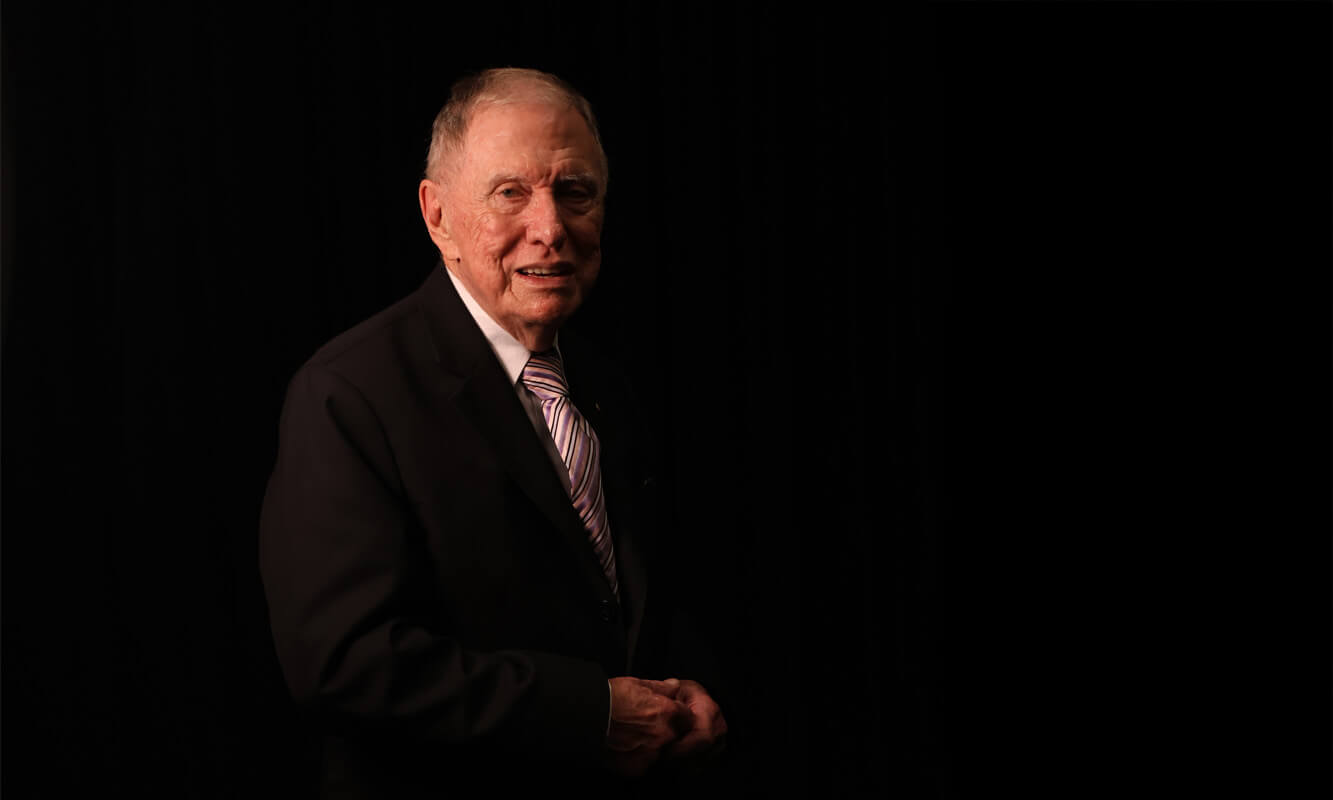
From his memorable “curtain call” case to his post-High Court career and work at the United Nations – The Honourable Michael Kirby AC has returned to The Callover podcast for an in-depth discussion with host Georgia Athanasellis.
Mr Kirby canvassed his experience working in the High Court from the mid-90s until his retirement in 2009, the value to be found in differences of opinion and his advice to the next generation of legal professionals.
Although Mr Kirby has previously said he doesn’t play favourites with the cases he has presided over, he did mention his final decision had been particularly memorable.
He was referring to his dissenting judgement in the challenge to the constitutional validity of the Northern Territory intervention, implemented by the Howard government in 2007.
Mr Kirby said his decision was handed down on the very last day of his service as a Justice of the High Court.
“This was the sort of curtain call,” he said.

“The question that was raised by the arguments put to the High Court was, did the Commonwealth provide just terms in a circumstance where the Commonwealth had not consulted the First Nations people, had not discussed the way in which their lives were going to be interfered with?
“The argument that was advanced, which I accepted, was that you had to provide proper consultation with the First Nations people.”
But Mr Kirby said he stood alone on this decision, with other justices not agreeing on the point of distinction.
“If we haven’t learned anything else in our dealings with the First Nations people over nearly 200 years, it is that we do not now continue just barging in and doing things allegedly for them without consulting them,” he said.
“I was left alone on the rock saying this distinction.
“I suggested, I didn’t spell this out, that the real reason for the Northern Territory Intervention was political. It was on the brink of an election, and it was another instance where something nasty was done to a minority because it was thought to be politically attractive.”
Mr Kirby said the issue was at the very core of the justice system.
“The relationship between the First Nations people, the settlers and their descendants is a matter at lying at the heart of the justice of the Australian Constitution,” he said.
In detailing his experience in the High Court, Mr Kirby said that it had been an “uplifting thing to be in a court where there was nobody who was receiving a brown paper envelope with cash and nobody was getting personal advantage”.
“Judges in Australia are not corrupted, they are honest, they are doing their best,” he said.
“They are striving to reach conclusions that were in accordance with the law.”
Mr Kirby said that although he sometimes disagreed on some matters differences in opinion, and the ability to navigate those, was a valuable thing.
“I’m not for just jumping on a box, on a particular point of view, but you tend to bring out the issues sharply and you bring out the issues more effectively,” he said.
“My colleagues on the court, some of them I had things in common with, but others I thought were just a bit too conservative for my perspective.”
“Mabo is a good instance of how sometimes, when you’ve got an area of law that has been unchanged for a time, there is a need to shake it and to change things a bit and that I conceived to be one of my functions on the court.”
After leaving the bench Mr Kirby was appointed Chair of the UN Commission of Inquiry on Human Rights Violations in North Korea – and has worked across a litany of other international matters and been involved in several bodies.
Mr Kirby urged young lawyers to follow in this tradition of joining in, applying an interdisciplinary approach and learning from others outside of the law.
“If you get a project, which has legal implications and will ultimately possibly have a statute or guidelines or some principles, you’ve got to consult, you can’t deal with matters out of your own little experience, which might not be broad enough,” he said.
He also urged the importance of respect.
“I always tell the young lawyers, or not so young, don’t go joking around in the presence of clients on their day for court or for mediation, because for them, this is not a big joke,” he said.
“I think it’s important for us as a profession to be kind and respectful and to other people and to try to help them. We are a helping profession.”
The Callover is a podcast created by young lawyers, for young lawyers. It is hosted by the QLS Future Leaders Committee, dedicated to inspiring a generation of connected, capable and healthy young lawyers. You can listen to the podcast on Spotify, Apple Podcasts, or your favourite podcast app.





Share this article