



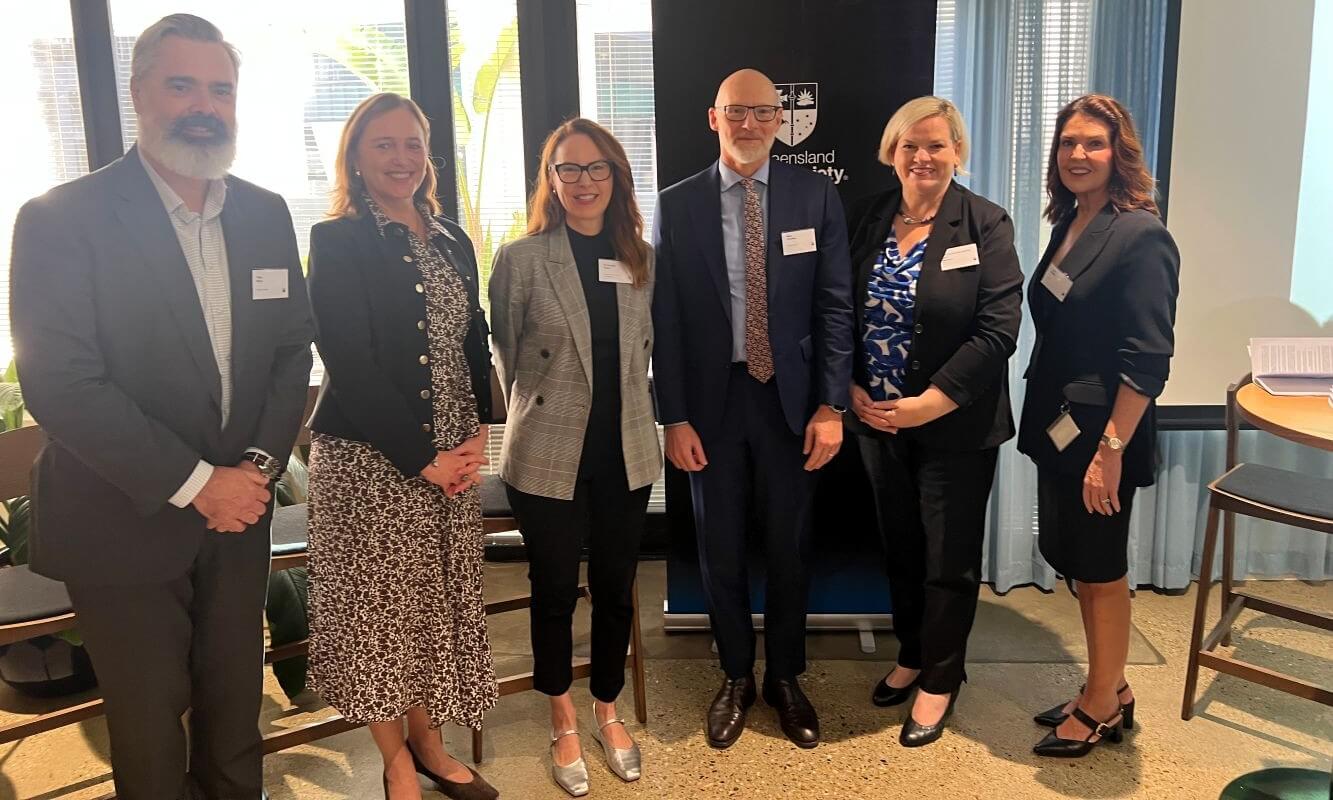
QCAT President Justice Mellifont has encouraged the profession to seek external mediation of appropriate matters to help ease its growing caseload at the inaugural Queensland Law Society Mediation Coffee Catch-up event.
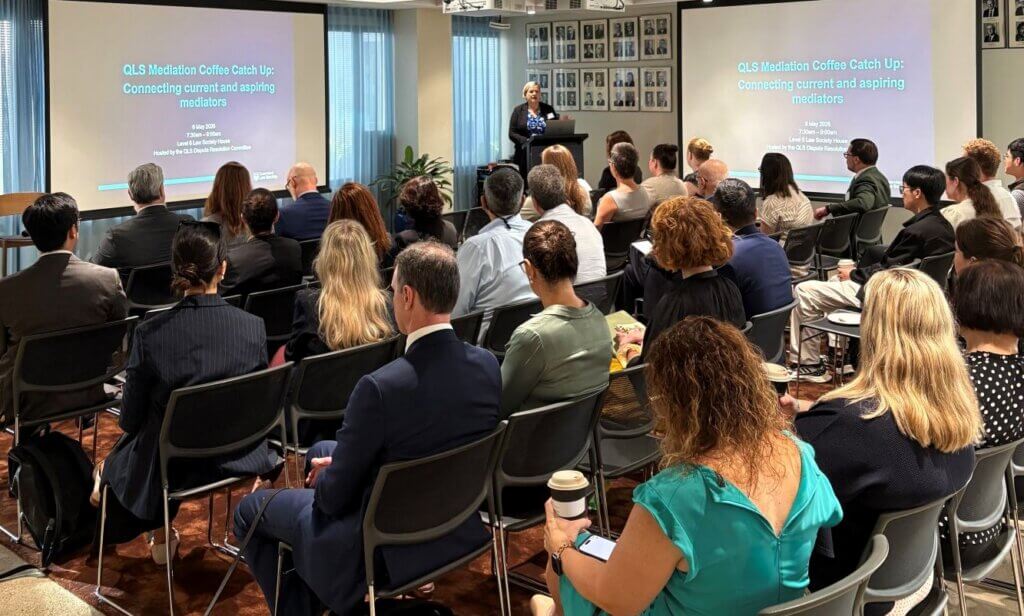
This month’s event, recently hosted by the QLS Dispute Resolution Committee, brought current and aspiring solicitor mediators together to network and hear from presenters and panellists about recent developments and to share their learnings from mediation and family dispute resolution practice.
Attendees had the opportunity to hear presentations from the Honourable Justice Mellifont and from Senior Member Samantha Traves about QCAT’s external mediation panel program.
Justice Mellifont urged the profession to consider seeking referral to the external mediation panel program to provide a further means of dispute resolution in QCAT litigation.
“This is an additional tool that QCAT can utilise in seeking to get through its enormous, and increasing, caseload,” Her Honour said.
“As you know, compulsory conferences are used as a type of ‘internal mediation’ at QCAT. QCAT has moved away from a default referral to compulsory conferences across most lists, to a more focused and intentional approach.

QCAT will continue to utilise compulsory conferences in cases where it is considered that there is a reasonable prospect that a compulsory conference will result in a meaningful outcome, whether that be partial or full resolution of the proceeding, or where it is desirable to provide a more informal setting to explain and work through matters.
However, QCAT is stretched for resources, and cannot provide compulsory conferences as quickly as parties might be able to achieve external mediation.
This external mediation panel program, spearheaded by Senior Member Traves, is aimed at providing another means of achieving early and economical resolution of disputes and to avoid the cost, expense and delay necessarily involved in proceeding to a hearing.”
Her Honour noted that with an increase in QCAT lodgements this financial year tracking at 14 per cent in non-MCD civil and administrative matters and an incredible 36 per cent in guardianship and year to date, the pressures on QCAT continued to grow.
“Even though QCAT has managed, this financial year, to achieve a 19 per cent increase in finalisations, and has conducted more than 8000 more proceedings this year than last, the concerning trend in increasing lodgements means that even these incredible gains might be outpaced by the number of matters coming in,” Her Honour said.
“All practitioners are encouraged to think about how they can assist QCAT achieving its statutory objectives – effective and intentional ADR is an important means by which this can be done.”
The QCAT Mediation Panel was established following a call for expressions of interest through QLS and the Bar Association, seeking nationally accredited mediators able to mediate matters in various areas of the tribunal’s civil jurisdiction. The response from the profession was enthusiastic and the inaugural panel was established. Membership of the panel will be periodically reviewed.
The list of QCAT Panel mediators is available on the tribunal’s website. The list includes the qualifications and contact details of each mediator, areas of jurisdiction within their expertise and daily or hourly rates for conducting a mediation.
The process is supported by Practice Direction 8 of 2025 and a Guide to panel Mediations on the QCAT website.
QCAT’s presentation was followed by an informal panel discussion.
Members of the Dispute Resolution Committee, Mark Brookes, Danielle Bozin and Toby Boys shared key learnings and challenges as experienced solicitor mediators and dispute resolution practitioners.
Mark Brookes, a mediator and partner with Carter Newell Lawyers spoke to the new national mediation standards (the AMDRAS) and commended the QLS Mediator Accreditation Handbook which outlines the accreditation and renewal process and the role of QLS in accrediting mediators under AMDRAS.
He also spoke to his experience as a mediator and the benefits of the Supreme Court pro bono mediation scheme for self-represented litigants. Mark is a strong advocate for the benefits of solicitors acting as mediators and the collegiality and willingness of fellow solicitor mediators to share their learnings.
Dr Bozin, an accredited Family Dispute Resolution Practitioner, provided an overview of the interaction between the AMDRAS and accreditation as a FDRP with the Commonwealth Attorney-General Department.
Dr Bozin observed that identification of family violence must be an ongoing process in family dispute resolution. This is particularly so in the context of coercive control. The challenges of family violence are underscored by ongoing CPD requirements in respect of family violence education for all FDRPs seeking to maintain accreditation.
Mr Boys, a long-standing Dispute Resolution Committee member and former chair, continued the conversation by providing attendees with an insight into his decision to open his own practice, DRM Legal, focussed on dispute resolution and mediation.
He outlined that one of the biggest challenges for solicitor mediators was encouraging the legal profession to consider briefing solicitor mediators for mediations. Panellists and attendees observed this appears to be mostly a matter of tradition.
The QLS Register of Solicitors includes a “Mediator” search function so legal practitioners across Queensland can easily locate QLS Accredited Mediators. There are also many QLS members with national mediator accreditation who can be found on the AMDRAS register.
Panel chair Julie Ruffin, Resolution Registrar at the Brisbane Supreme Court, reminded aspiring mediators or those just starting out to look for other opportunities to build experience and obtain their mediation hours.
There are several community legal centres which provide mediation services. In addition, the Supreme Court’s Pro Bono Mediation scheme for self-represented litigants also facilitates a co-mediation model with senior practitioners so that more junior mediators can build upon their skills and networks.
QLS, in consultation with its Dispute Resolution Committee, continues to look at opportunities to build connections within the solicitor mediator branch of the profession and to support aspiring mediators by connecting them with senior practitioners including co-mediation models where possible.
The committee looks forward to hosting its next catch-up in October and always welcomes feedback and questions regarding the Committee’s work to policy@qls.com.au.





Share this article