



After some detours and a bumpy ride, India’s first scent trade mark has cross the finishing line, victorious.
Japanese tyre manufacturer Sumitomo Rubber Industries gained its trade-mark registration for rose-scented tyres after a bumpy, two-year journey, encompassing roadblocks and the road untravelled.
As you will be aware, trade mark usually relate to brand names (eg. Apple) or logos.

Trade-mark protection for non-traditional trade marks can be a slippery road to travel and include:
- Colour
- Scent
- Shape
- Sound
- Movement.
Australian roadmap
The Australian trade marks register boasts a grand total of 19 scent-mark applications, only two of which have obtained registration:

- Trade mark number 1241420 for the scent of Eucalyptus Radiata on golf tees, registered in 2008 and renewed in 2018, which remains valid until 2028 (when it is due for further renewal);
- Trade mark number 1858042 for the scent of cinnamon on non-wood based furniture made principally of foam, steel, plastics and melamine-coated particle board, registered in 2017 and due for renewal in 2027.
Two remain pending (having been filed on 6 March 2025, received official objections which have not yet been overcome, with a deadline for resolution of objections of 17 September 2026):
The remaining 15 Australian scent trade-mark applications took an off-road detour, becoming bogged down and never taking the chequered flag of registration.
Indian tyre trade mark
The Indian rose-scented tyre trade mark was running on all cylinders in its two-year uphill battle to obtain registration.
Navigating tricky terrain through multiple hearings, the tyre manufacturer finally gained traction and won the race in top gear.
Roadblocks along the way included strong official objections from registry officials that the trade mark:
- Lacked distinctiveness (an essential element for registration of any type or trade mark);
- Lacked a proper graphical representation; and
- Created uncertainty as to the scope of protection.
The first official objection was fairly easily dispatched. Tyres usually smell like rubber. Tyres that smell like roses would be quite distinctive and would serve to create an immediate and unmistakable association with a single commercial source, namely Sumitomo. Race over, podium secured on this ground.
The second official objection is not one that has prevented the two lone Australian scent marks from registration. The Australian marks are described in words, for example “The mark consists of a Eucalyptus Radiata scent for the goods”, being golf tees.
Instead of this simple approach, the Indian officials ventured off track and instead of agreeing to a purely verbal description of the trade mark, opted to require a graphic representation, created with the support Indian Institute of Information Technology, paired with a written description as follows:
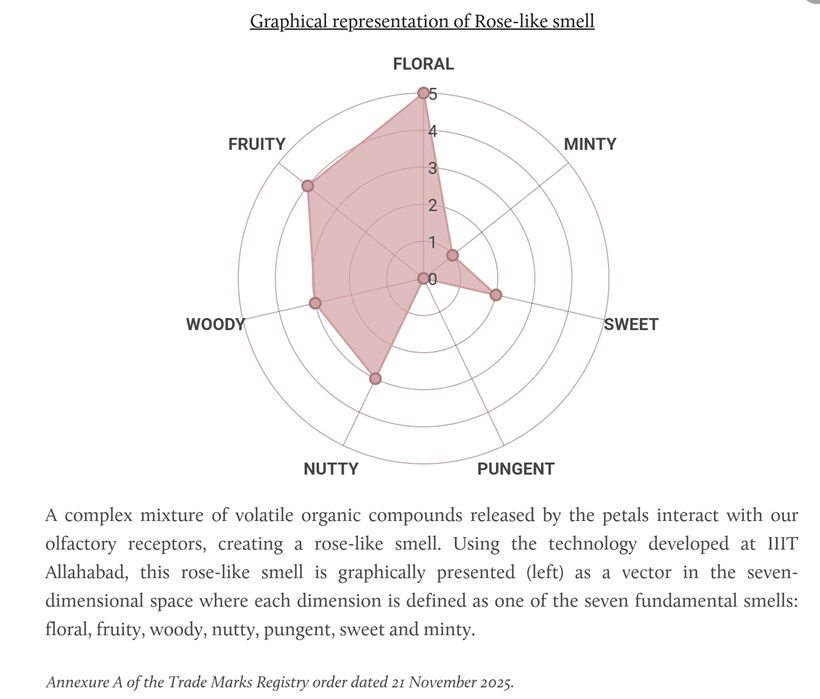
This graphic and written description overcame the third official objection, by more precisely defining the exact nature of the smell protected by the trade mark.
The global track
In 2002, in Ralf Sieckmann v Deutsches Patent- und Markenamt, the European Court of Justice held that a scent mark could not be registered because it was not sufficiently “clearly and precisely defined”, where the scent mark was described in words and illustrated with a chemical formula. Indeed the court held that:
In respect of an olfactory sign, the requirements of graphic representability are not satisfied by a chemical formula, by a description in written words, by the deposit of an odour sample or by a combination of those elements.
The UK took a much simpler approach, with Sumitomo’s rose-scented tyre mark coasting to the finish, to become one of the UK’s first olfactory trade mark registrations 30 years ago under UK trade mark UK00002001416, using this simple description: “The trade mark is a floral fragrance / smell of roses as applied to tyres”.
The USA’s approach is also smooth riding on the tarmac, with a written description sufficing, for example, allowing registration for a trade mark for play dough for “The mark is a scent of a sweet, slightly musky, vanilla fragrance, with slight overtones of cherry, combined with the smell of a salted, wheat-based dough”. Good luck to anyone trying to reduce that to a graphic representation for trademark protection in India!
The finish line
Unconventional trade marks are capable of protection, but you may easily run out of road, especially given the differing requirements and local practice in each country.
The standard road rules apply:
- The trade mark must be distinctive of the particular goods / services;
- It must be represented on the relevant trade-mark register in a manner that is clear, easily understood and objectively understood. Local laws will determine how this can be achieved, with some allowing a simple description and others abandoning the highway for the horizon.
Principles, practice and tips for Australian scent trademarks
Scent marks can be registered in Australia – but only in rare circumstances. As of 2026, only two have ever been successfully registered, and IP Australia treats them as one of the most difficult types of non‑traditional marks to secure.
The core test remains distinctiveness.
As with all trade marks, the scent must distinguish one trader’s goods from another’s. The same legal principles apply as for names or logos – but achieving distinctiveness for a smell is inherently more difficult.
Natural or functional or industry-common scents can never be distinctive.
These scents are unregistrable because the smell describes a feature of the goods, not the trade source. Examples include:
- cedar smell for cedar wood;
- lemon-scented cleaning products (lemon extract has known cleaning properties and other traders might legitimately want to use lemon extracts in their cleaning products);
- minty scent is commonly used in the toothpaste industry, no one toothpaste manufacturer can monopolise this common scent.
IP Australia’s Examination Practice (very strict)
IP Australia’s official Manual explicitly states that scent marks are “one of the most difficult non‑traditional signs to represent graphically”.
Key requirements:
A verbal description can be accepted as the graphic representation.
Examples provided by IP Australia include:
- the smell of roses applied to plastic storage boxes;
- the smell of apple blossoms applied to car tyres;
- the strong smell of bitter beer applied to the flights of darts.
Unlike India’s recent approach, Australia does not require a diagram or chemical analysis.
Technical chemical data is not acceptable in Australia.
IP Australia rejects highly technical representations such as:
- Chemical formulas;
- Spectrometry results;
- Chromatography data;
- “Electronic nose” data.
The standard is what an ordinary person could understand, not a scientist.
Examiners may request a scent sample.
A specimen is not required at filing, but IP Australia may need a sample during examination to verify the description.
Tips for increasing chance of registration of scent trade mark in Australia
Make sure the scent is highly unusual for that product
Distinctiveness is strongest when:
- The product does NOT normally have a smell, OR
- The chosen smell is unexpected in the context of the product claimed in the trade-mark specification.
Provide a precise, objective description that is understandable without technical expertise
Eg The Australian trademark registration for “a cinnamon scent applied to non‑wood furniture”.
Consider consumer perception evidence
If the scent has been heavily used and promoted, evidence of acquired distinctiveness may help. However, mere evidence of use, no matter how extensive, will not get a trade mark over the line. Evidence must go further and prove that the scent acts as a badge of origin for that trader, to the exclusion of all others in that field.






Share this article