


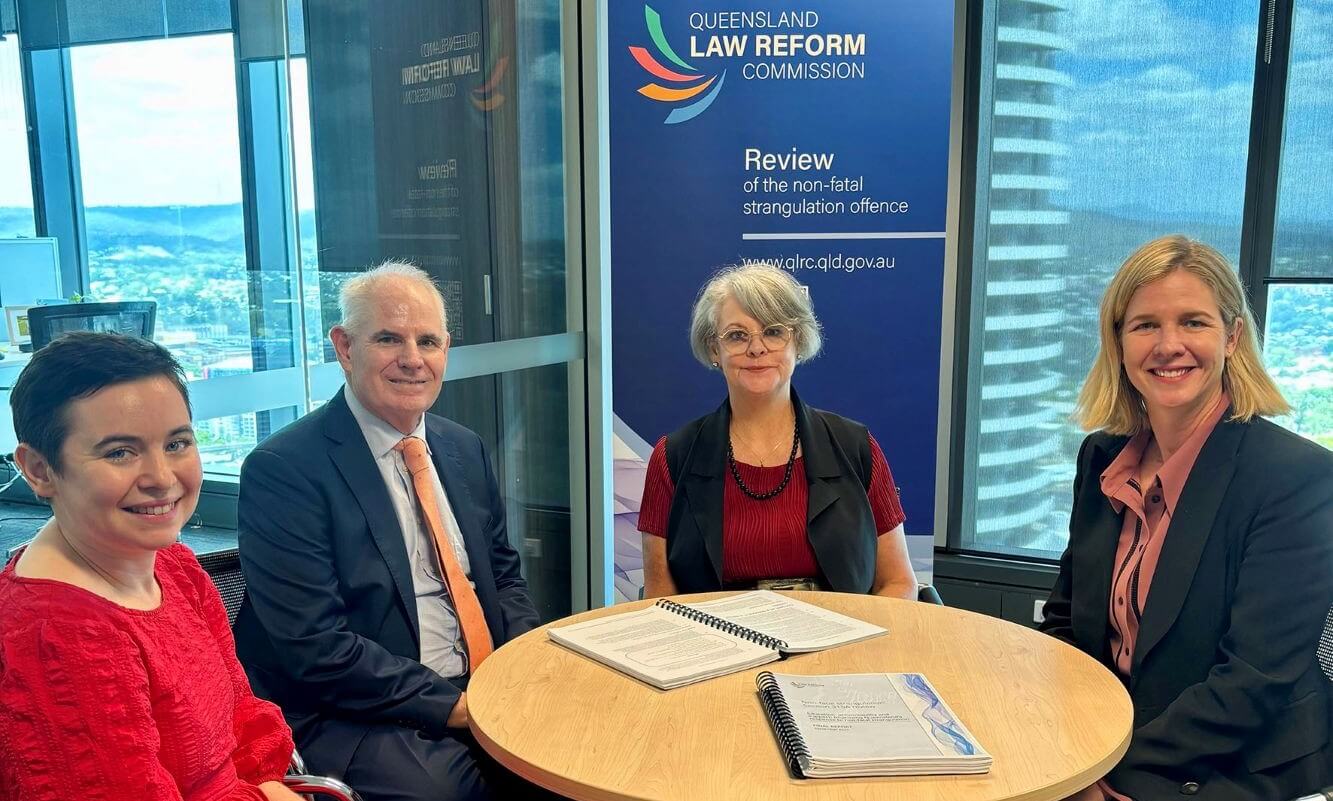
The Queensland Law Reform Commission’s final report on its review of the non-fatal strangulation offence in the Criminal Code makes 18 recommendations for reform.
Queensland Law Society made a submission to the Commission in 2025 with the QLRC report, Education, Accountability and Support: Improving Queensland’s Response to Non-fatal Strangulation, being tabled in Parliament this week.
In 2024, the QLRC was tasked with examining the offence of ‘Choking, suffocation or strangulation in a domestic setting’ in s 315A of the Criminal Code (Qld) (the ‘non-fatal strangulation offence’), and applicable procedural rules and practices.
This included making recommendations on terms such as choke, suffocates and strangles; the current maximum penalty of seven years imprisonment; and if the offence should be able to be finalised in the Magistrates Court, and in what circumstances.
During the review, the QLRC released two background papers, a consultation paper and two research reports.
Chair Fleur Kingham said the QLRC recommendations started with education and also focused on accountability and support.

“Our response to non-fatal strangulation must address misconceptions about the risks,” she said.
“The risks are not well understood. The impacts can be physical and psychological, are sometimes delayed and can be very serious.
“Surprisingly little pressure is required to do damage.”
The QLS submission supported the position that further training on non-fatal strangulation for criminal justice personnel was needed.
“It is of the view that further education and training in relation to the investigation and prosecution of these offences will enhance the understanding of those tasked with identifying, charging and prosecuting this type of offending, and thereby address any perceived inadequacy with the current criminal justice response,” the QLS submission said.
In the Chair’s summary, it says the recommendations aim to educate the public and relevant professionals about the risks and dangers of strangulation; enhance the operation of s 315A; better respond to the non-fatal strangulation in circumstances beyond the scope of s 315A; address systems issues; and create a robust evidence base.
On the issue of evidence and data collection, QLS submitted: “It is important to assess how frequently non-domestic strangulation offences occur and in what contexts (e.g. assault, following online dating interactions, organised crime violence).”
Some of the Commission’s other recommendations are:
- Enhancing accountability with expanded ability to prosecute the conduct across a variety of relationships in both sexual and violent contexts;
- Improving the investigation, charging, prosecution and sentencing of non-fatal strangulation;
- Improving the experiences of victim-survivors in the justice system.
The report recommended that penalties should be applied that reflect the seriousness of the conduct, and that such conduct be reflected as an aggravating factor on sentence where appropriate and recorded as non-fatal strangulation upon conviction.
The report stated a few stakeholders considered that the penalties proposed in the consultation paper were too high.
Queensland Law Society submitted: “There are drawbacks to increasing the maximum penalty. The motivation to defend a charge with a higher penalty will be greater and more likely to be resisted.”






Share this article