



March is Brain Injury Awareness Month, a time to shine a light on the challenges faced by individuals affected by brain injuries and to promote better understanding, care and support.
As a personal injury lawyer, I regularly work with clients who have suffered from brain injuries. Every four minutes someone in Australia is hospitalised for a head injury1, which is an alarming statistic.
Head injuries are commonly classified as mild, moderate, or severe based on their impact on brain function. Yet even injuries labelled “mild” can have significant long-term consequences, which are often misunderstood in clinical, workplace, and sporting environments.
The Australian Institute of Health and Welfare published in 2020-21 that head injuries resulted in 406,000 emergency department (ED) presentations, 142,000 hospitalisations and 2400 deaths. These head injuries accounted for 21 per cent of all injury ED presentations, 25 per cent of all injury hospitalisations and 17 per cent of all injury deaths2.
Despite increasing awareness, concussions and mild traumatic brain injuries remain under-reported and poorly recognised. Many people never present to hospitals at all, meaning official numbers likely underestimate the true scale. Of the injuries that were reported in 2021–22:
- 17,700 ED presentations were for concussion;
- 10,800 resulted in hospitalisation.
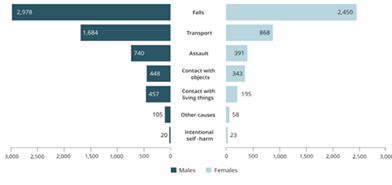
Falls were the leading cause of concussion hospitalisation, followed by motor vehicle and bicycle accidents, as shown below.

(Table 1) Number of concussion hospitalisations, by cause and sex, Australia, 2021-22
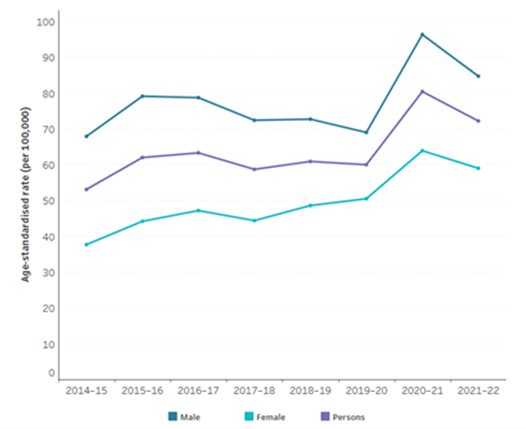
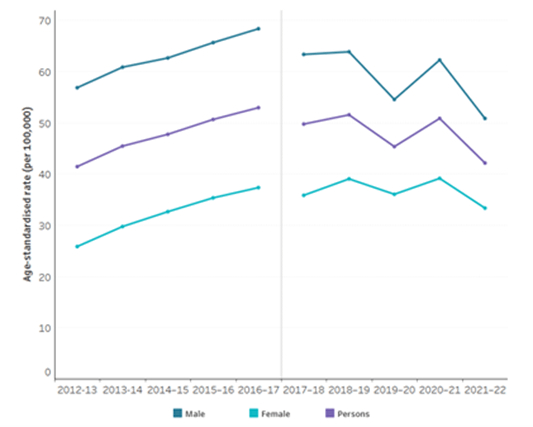
Yet even as ED presentations increase (graph 2), average hospital stay durations for concussions have decreased (graph 3). While this may reflect improved triage and management, it also raises the question of whether shorter admissions risk prematurely discharging patients without appropriate follow-up.
(Graph 2) Age-standardised rates of concussion ED presentations, by sex, Australia, 2014-15 to 2021-22
(Graph 3) Age-standardised rates of concussion hospitalisations, by sex, Australia, 2012-13 to 2021-22
In recent years there have been advancements in research, resulting in Concussion Guidelines in sport and the ANZ Concussion Guidelines for clinical practice (“guidelines”). The ANZ Concussion Guidelines3 have identified that 20-50 per cent of people with concussions experience ongoing problems that can last months or years after their injury. This is a striking statistic, and one with serious implications for return-to-work decisions, schooling, workplace safety obligations, and potential liability.
The guidelines for clinical practice provide practical guidance on the assessment and management of concussions including long-term management of persistent symptoms. It addresses managing common symptoms such as cognitive difficulties, fatigue, headaches and balance problems. It also provides guidance on returning to work/school, sport and driving. It is anticipated that these guidelines will support doctors in delivering more proactive care and advice, while also helping them identify when to refer patients to specialist services for timely and appropriate treatment and rehabilitation to help improve outcomes.
The guidelines outline several key recommendations designed to strengthen recovery outcomes. Early intervention remains central, with timely recognition of concussion, immediate removal from play, and clear patient education. The guidelines endorse a graded return to activity and outlines that optimal management requires a multidisciplinary approach, involving general practitioners, physiotherapists, psychologists, and occupational therapists in the coordinated care of individuals experiencing persistent post-concussion symptoms.
The guidelines will help ensure that concussions are recognised early and acted on promptly, giving individuals the best chance at a timely recovery. This is welcome progress. But there is still a gap between guidelines and real-world practice. There is an opportunity here for industry leaders to push for more consistency in concussion management, better early intervention systems and more education across workplaces, schools and sporting institutions.
Brain Injury Awareness Month is an opportunity to advocate for improved concussion care and support for those affected. By raising awareness, we can help ensure that individuals receive timely, evidence-based care and the right education around brain injuries including concussions, to assist in achieving better outcomes. With the right systems, these brain injuries can be better recognised, better supported, and better prevented.
Footnotes
1 The Australian Institute of Health and Welfare, Head injuries in Australia 2020-21 report, data source AIHW National Hospital Morbidity Database, www.aihw.gov.au/reports/injury/head-injuries-in-australia-2020-21
2 Ibid
3 https://anzconcussionguidelines.com/guidelines-main-sidebar/








Share this article