



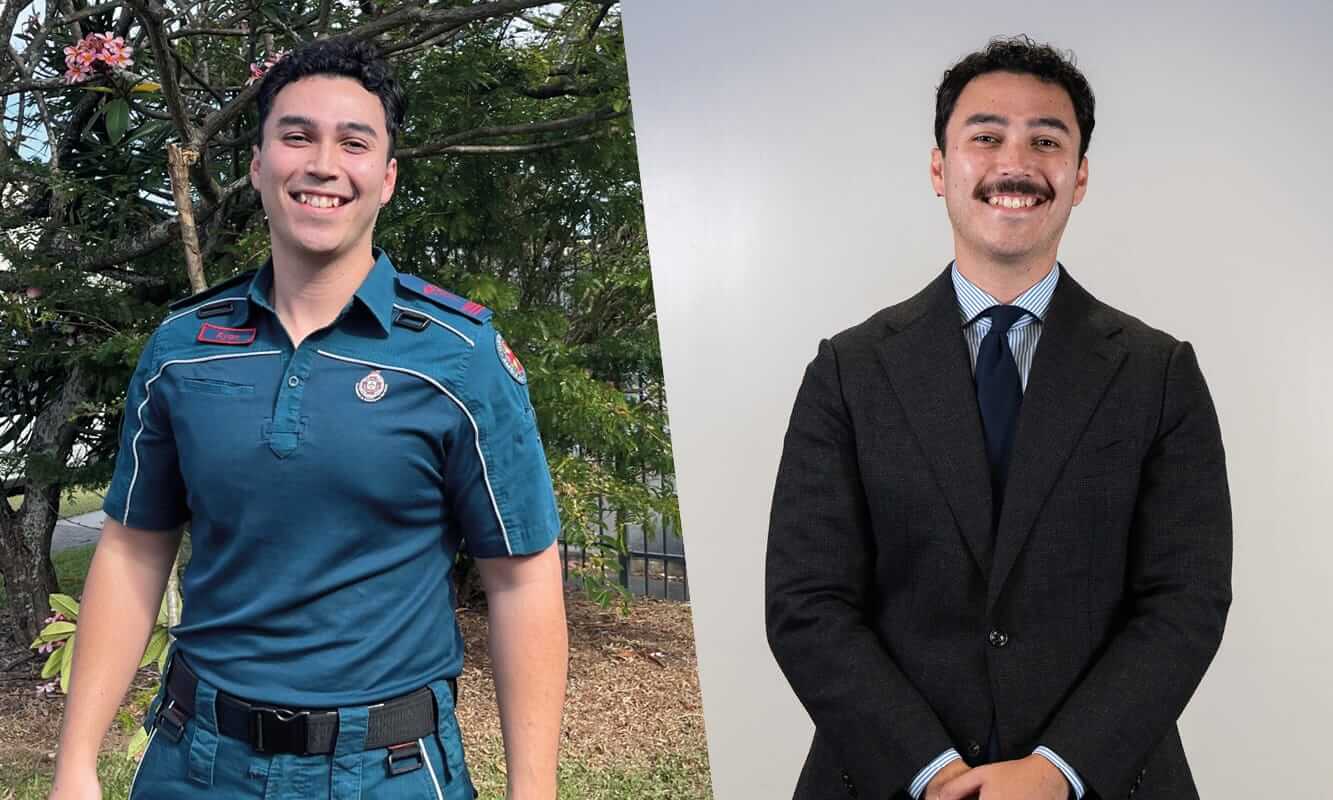
Former paramedic Ryan Lang might miss going “lights and sirens” to cut through traffic, but his new role as a graduate legal officer allows him to continue focusing on helping people.
Ryan is part of the inaugural Department of Justice Law and Justice Graduate Program cohort, along with Emma Kendall.
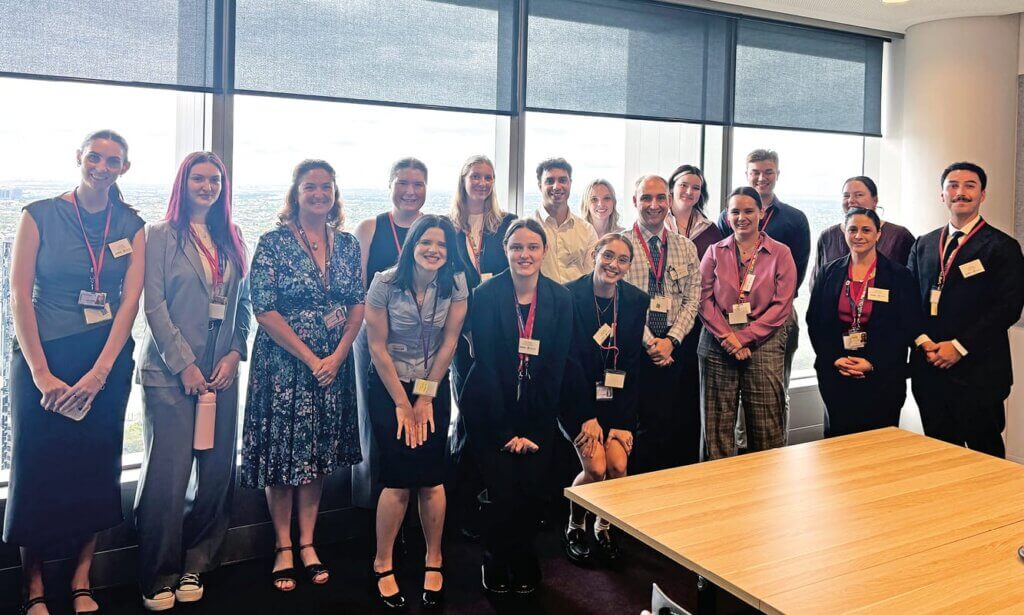
The department welcomed 14 graduates, who have joined teams across Courts and Tribunals Services, the Office of the Director of Public Prosecutions, Forensic Science Queensland, the Registry of Births, Deaths and Marriages and Corporate Services.
Ryan has been placed in the General Counsel Legal Advice and Advocacy team after nearly five years as a paramedic – first for a private firm then with Queensland Ambulance Service. He studied for a Biomedicine degree before going on to complete his Juris Doctor.
“On paper, it makes more sense if I had gone and chosen a different health career like physiotherapy,” Ryan said.
“At the same time, I wanted to do something completely different, something I can look at with fresh eyes, per se, but also retain the reason why I chose paramedicine as an initial career.
“I want to help people. I want to make a positive impact, really, to the community, as cheesy as it sounds.
“It really gave quite a lot of fulfilment and joy as a paramedic seeing the positive impact I made. But there were a couple of downsides in that career.
“I missed quite a lot of quality time with friends, family. You give up quite a lot doing the shift work because the ambulance service is a 24-7 service with quite long hours, which I was fine doing.
“I enjoyed the work, but at the same time I missed quite a lot of family and friend events, birthdays, get-togethers. I wanted to find something that can fulfil that part of my life – so law.
“I had a few friends who did law and are lawyers now. I’ve got one in Perth and I contacted them and they told me what I wanted to know what being a lawyer was like, what that career path was like. And they only spoke highly of it. So I thought I’d give it a shot.”
Ryan also enjoyed his Juris Doctor degree at Bond University and found inspiration there.
“I had an amazing lecturer. Her name’s Dr Narelle Bedford. She taught the administrative law subject at Bond Uni. She made that subject a lot of fun and super interesting,” he said.
“So from there, I tried to find a job in the public sector that reflected the enjoyment I had at admin law. The graduate program is really enjoyable and there’s a whole lot of variety. Nothing is the same, which is a bit like what I did as a paramedic.”
However there are moments and aspects of his former career that he misses.
“Firstly, being able to go lights and sirens and cut through traffic, the high adrenaline stuff, that obviously I miss that. I do miss my friends who are still in the QAS,” he said.
“And I do miss the one-on-one, I guess time that you get with, in that sense, patients. I don’t get much face-to-face contact with the clients in this role, which I’m fine with. At times it can be confronting, but then again, the context of the jobs is very different.”
As to be expected, Ryan faced some confronting situations as a paramedic that he does not miss such as attending motor vehicle accidents, and especially challenging calls when children were involved.
“The most traumatic thing I’ve ever experienced on the job was dealing with children. I love kids. Kids are great. Unfortunately, being a paramedic, you don’t see too many healthy kids. It’s always a sick bubba.”
Now Ryan happily spends his time helping and supporting team members with legal research, looking up cases and working on advices.
The program is designed to give graduates a strong, supported start, combined with meaningful hands-on work with learning, development and mentoring.
It’s about helping graduates build skills, confidence and connections while gaining insight into the breadth and impact of the department’s work.
Senior Talent Strategy Advisor Sarah Henderson said she was excited to have had the opportunity to work on the new Law and Justice Graduate Program pilot following sector‑wide findings that Queensland faced a growing need for early‑career legal and justice professionals.
“The Public Sector Commission identified a strong demand for legal talent across government, alongside a clear gap in early‑career pathways capable of attracting and developing that capability,” she said.
“In response, the department took the lead in developing and implementing the Law and Justice Graduate Program pilot – a purpose‑built model designed to support graduates seeking meaningful, community‑impactful careers in public service.
“The pilot will allow DoJ to test, learn and refine the model before consideration of expansion to a whole‑of‑sector program. This staged approach ensures the program remains evidence‑led, practical and responsive to the needs of both graduates and business areas.
“The two‑year development program offers permanent employment from commencement, the option to rotate across divisions, a centralised professional development program in addition to financial support to complete external training related to their speciality as Practical Legal Training.”
Ms Henderson said early engagement through universities, careers fairs and professional events generated significant interest, showing a clear appetite for careers in the sector.
“This program received more than 500 applications, far exceeding expectations for a first‑year pilot and demonstrating that graduates are actively seeking opportunities across Queensland to strengthen communities, uphold human rights, and ensure justice for all,” she said.
“The 14 graduates who make up the 2026 cohort commenced on 2 February, began their journey with a comprehensive week‑long induction that introduced them to the department, the justice system, the Queensland Parliament, and their new graduate community.
“This cohort has brought with them fresh perspectives, curious minds, and big hearts. I can’t wait to see what they all achieve.”

Emma was also accepted into the program, and is currently working in Courts and Tribunal, including the Supreme, District and Land Courts.
Like Ryan, her path to the law was not a direct line. Emma started university studying a communications and business degree before she decided to pick up a law degree. After switching to a dual arts/law degree, she studied intellectual property and technology law as a Master’s degree in the US as part of a partnership with the University of Queensland.
Then Emma worked in another Queensland government organisation for almost a year and a half and while working there decided to apply for the DOJ graduate program.
“I was drawn to law because I really wanted a career where I would be continuously learning and challenging myself,” she said. “I really saw it as a career that would be filled with that lifelong learning and problem solving and adaptation.
“There’s different legal and societal changes that arise and I gained more exposure during uni, that exposure to practice, particularly volunteering at community legal centres.
“Something I was really struck by was how much of a privilege it is to have a legal education, as it enables you to interpret and navigate these really technical, and often complex, laws and institutions.
“Lawyers have this ability to act as key holders for the public, essentially helping them to unlock solutions to legal problems that might have previously felt hidden or inaccessible.
“That’s what ultimately led me to decide to actually practise law, as I really wanted to help people navigate through those difficult situations.”
Emma said the public sector offered diverse pathways and opportunities, and it was an exciting time to do meaningful work.
“It’s an opportunity to do that really meaningful work for the public as the state develops in the lead-up to the Olympics,” she said.
“Working within the government, I found that it also gives you access to really exciting secondment opportunities that might pique your interest along the way, so you can follow your curiosity.
to very interesting parts of the ecosystem that you might not previously have really envisaged yourself working in.
“I was particularly excited to be part of the pilot program as we’ve really been given the ability to guide the direction of our program and tailor it to our interests. It’s been really wonderful.”
Emma said she had been involved in working on the courts and tribunals digitization program.
“That’s a really exciting program and hopefully we’ll be able to make the justice system more accessible and efficient for Queenslanders by developing those digital technologies,” she said.
“At the moment, just being in this graduate program, I think I’m most excited to, just at this very, very early stage of my career, try and get as much diverse experience as possible and build a strong foundation of practise that hopefully I can draw on as I progress throughout my legal career.”







Share this article