


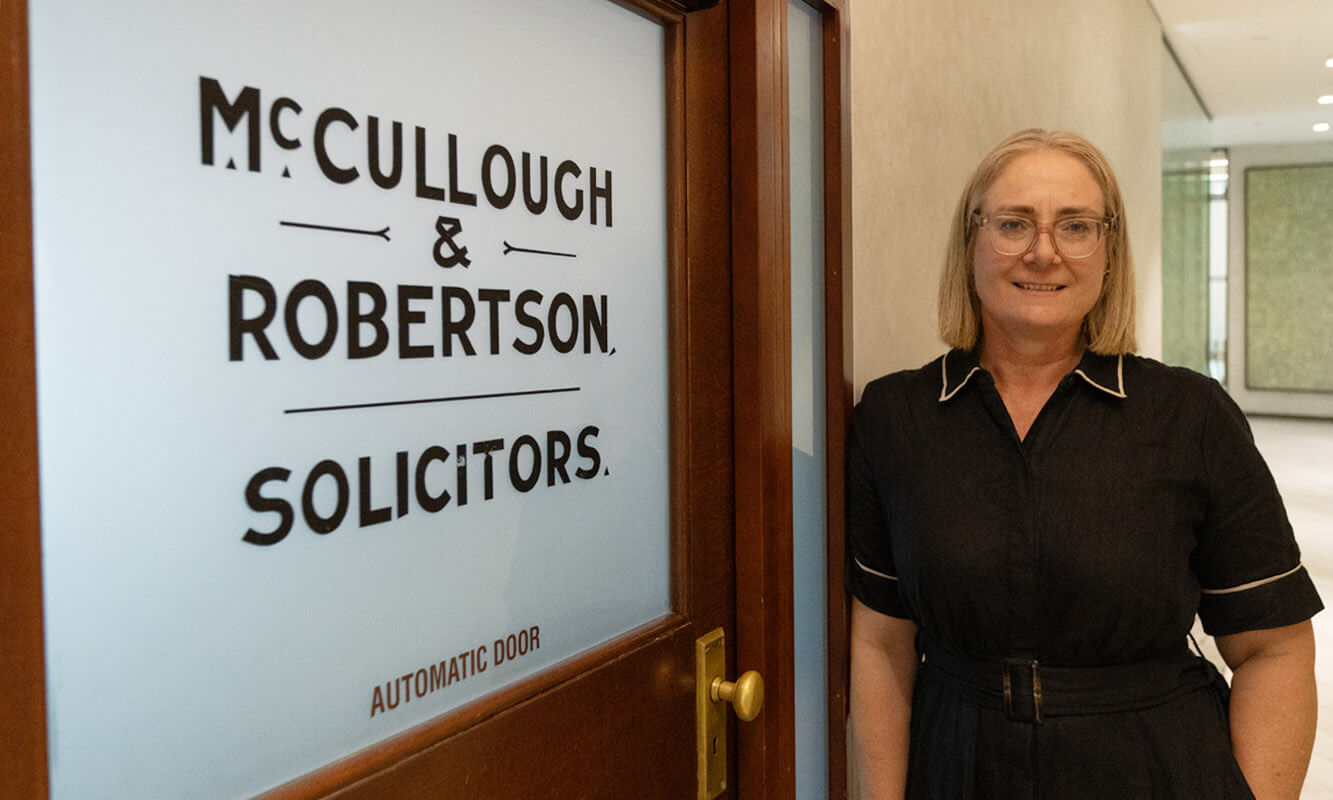
This January marked 100 years since Robert McCullough from Barcaldine joined with Brisbane’s Jack Robertson to found a ‘generalist firm grounded in agriculture’ – McCullough Robertson.
In the years since, Brisbane has thrown off its ‘big country town’ stigma and Chair of Partners Kristan Conlon said the firm has grown too but still stays true to its origins serving graziers and agricultural businesses.
“The firm was grounded in primary producers being our initial clients,” Ms Conlon said. “And that’s really shaped a lot of our culture going forward.”
“They’re down-to-earth people, salt of the earth,” she says of those founding clients and Partners. “And I think that’s really flowed through from our founders in 1926 all the way through now.”
That connection to regional Queensland has not been left to sentiment. The firm’s Food and Agribusiness team remains one of its leading industry groups with Partners and staff regularly out in the regions rather than waiting for clients to make the trip to Brisbane.
“We’ve been lucky to be able to stay connected and I’m even advising clients now from not much after 1926, where the first family member worked with the firm and we have been fortunate to support them across their full life cycle and are excited to be working with the next generation now,” she said.

Deliberate growth not expansion for its own sake
While grounded in its origins, Ms Conlon says the firm has also kept pace with the world around it, though evolution has been methodical. She points to the 1970s when it added estate planning and taxation to its practice.
“Some of that was a bit groundbreaking at the time, to be thinking about that,” she said, noting that the firm had grown into a fully-fledged commercial practice during the 1980s.
One of the next major evolutions was a move to Sydney, which Ms Conlon says at the time was a big decision.
“It wasn’t one we took lightly,” she said. “We had many, many conversations around the partnership table about it, but it really was rooted in what was best for our clients and how we could best service them.”
“Sydney was a key location so it was a great decision for us and it meant we could really unlock the ability to service our clients better across the Eastern Seaboard.”
While eyeing growth, the firm resisted the internationalisation wave that swept through the Australian legal market over the past two decades, choosing instead to remain an independent Australian firm.
Ms Conlon is unapologetic about that position. Independence, she argues, keeps the firm nimble and keeps decision-making anchored in Australia – for clients and for the people who work there.
“Clients operate across borders and we’ve demonstrated that we’ve got the teams that can do the cross-border work with our strong referral network, so we are advisors with international context but deep understanding in Australia,” she said.
“And I think that’s what clients are looking for. Not necessarily that you do have those offices in every city around the world, but that you know how to service well wherever they are and that you understand the industry they’re in.”
It is a philosophy that echoes what Ms Conlon describes as organic growth, ensuring that expansion serves purpose rather than ego.
“We’ve been really focused on that organic growth,” she said. “By growing organically and really guarding our culture, it means we get the right people. And we are a people business.”
The war for talent
The legal profession Ms Conlon joined in the late 1990s was one where firms could afford to be selective about graduates. That dynamic has shifted markedly.
Today, the competition for talent – at every level, from early career lawyers through to experienced partners – is, in her assessment, the defining challenge facing firms of McCullough Robertson’s scale.
“We’re a people business at the end of the day and the competition for talent is intense,” Ms Conlon said.
“And that’s something that we really focus on, our team and our people, and really working to ensure that we create any opportunity that we can to combat that challenge, bring great people through, foster and support them.”
The firm’s response centres on culture as a genuine differentiator rather than a marketing exercise. Flexibility, inclusion and clear pathways to progression are described not as aspirations but as operational realities.
Ms Conlon said early career lawyers were given exposure to full transactions from the outset.
“We like to get our people in early. We like to let them see a whole transaction. Those kinds of things are really our focus for our people,” she said.
“We’ve got quite a young partnership as well. And I think having a young partnership of really dedicated partners that all get along helps because early career people that do have these expectations can see that they want to be a part of that.”
The firm promotes from within with 20 per cent of the current partnership starting as graduates.
Retention data supports the narrative as 16 per cent of the firm’s staff have been with McCullough Robertson for more than a decade. In a sector where mobility is high and loyalty can be temporary; it is a number the firm wears with quiet pride.
The long arc of change
When Ms Conlon joined McCullough Robertson in 1998, the firm had one female partner. The broader profession was male-dominated and had been for generations.
The shift since then has been considerable, though Ms Conlon is careful not to overstate how it occurred.
“It’s happened naturally, but also firms like McCullough Robertson have, with intention, ensured that we give support to every person who needs it appropriately,” she said.
The partnership now sits at 60, with female partners comprising 35 per cent of that group as of February 2026.
Ms Conlon points to markers of intent in that balance, noting the firm has promoted multiple female partners while they were on parental leave.
“And that’s been a great example because people can see that having children, starting a family or anything else that might have traditionally inhibited your growth in a business is not going to be a barrier to progression at McCullough Robertson,” she said.
Looking Forward
For a firm grounded in history, McCullough Robertson is clear-eyed about where its next decade of growth lies. Ms Conlon nominates three areas: artificial intelligence, energy transition and infrastructure.
On AI, her position is measured.
“AI is on the tip of everyone’s tongue,” she said. “And I think that’s about responsible and sustainable work to ensure efficiency and to embrace that as we need it. But knowing that we’re lawyers well and how that looks in a responsible fashion.”
Ms Conlon says the firm has been positioning itself in resources and renewables for some time, describing it as a significant opportunity.
“And we’ve spent a lot of time and investment and we’re well down the path in working with multiple clients in that space,” she said.
“We’ve got a renewables and resources industry team that work across all of the different practice areas and we’re keen to continue to play our part in relation to that energy transition.”
The firm is also bullish on infrastructure in the lead-up to 2032.
“You can’t help but have a buzz,” Ms Conlon said.
“In Queensland around 2032 and the Games that are coming, that is going to bring a global interest to all of Australia and not just Queensland.
“There’s going to be a lot of infrastructure, a lot of planning. And we’re keen as one of the leading law firms in Queensland to be at the forefront.
“And that’s a growth opportunity in itself. I don’t personally see Queensland going backwards. I see it going forward and that’s an opportunity for every service provider in the state.”
Looking forward, looking back
In reflecting on the decisions of the past 100 years, Ms Conlon says she is mindful of the Partners to come, and how they will reflect this period of the firm’s history.
“I think I would want future managing partners to know that our decision-making and our way forward is grounded in gratitude and gratitude from the very beginning, from our founding partners in 1926 all the way through,” she said.
“I was fortunate enough to work with former chairs of the firm and I remain in contact with them now.
“I’d want them to know that the values that we have as a firm of being generous, committed, down to earth and commercial, they remain and they pervade everything that we do.
“And we have managed to continue to live and breathe those values every day.”
Ms Conlon points to the McR’s $1 million commitment to pro bono support to the Australian community housing sector, saying it is a considered response to one of the country’s most pressing social crises.
“We back our values with action and this is a space where McCullough Robertson can really assist,” she said.
One hundred years is a long time in any industry. In the law, where firms fold, merge, rebrand or disappear into global networks on a regular basis, it is a rare achievement.
Ms Conlon says she is proud that McCullough Robertson has reached the milestone by doing something quietly difficult: staying true to a culture while still evolving around it.
“Every single person that’s worked with us is proud of the journey that we’ve come on,” Ms Conlon said. “And that we make an impact in the lives of others through the work that we do.”






Share this article