



Scenario: “Settlement is due today. The purchaser, who ordinarily resides in Australia, is funding the purchase from several sources, including an account in the purchaser’s own name with an overseas bank. The purchaser explained the account was retained after living and working in that country. Does the overseas transfer itself justify an SMR – or is it simply information requiring assessment? My client has triggered a red flag. Do I have to lodge a Suspicious Matter Report?“
The answer may be affected by the jurisdiction involved. A connection with a jurisdiction presenting heightened ML/TF risk – including one identified by the Financial Action Task Force (FATF) – is a relevant risk indicator, but it does not, without assessment of the surrounding circumstances, automatically establish reasonable grounds for suspicion.
It is a question many legal practitioners will understandably ask now that Australia’s anti-money laundering and counter-terrorism financing (AML/CTF) regime applies to the legal profession.
The answer is not determined by the existence of the red flag alone.
A red flag is an indicator that something requires closer attention. The fact that information is classified as a red flag does not, without contextual assessment, establish reasonable grounds for suspicion under section 41 of the Anti-Money Laundering and Counter-Terrorism Financing Act 2006 (Cth) (AML/CTF Act).1 This article assumes that one of the service-related conditions in section 41(1)(a)-(c) is satisfied.2
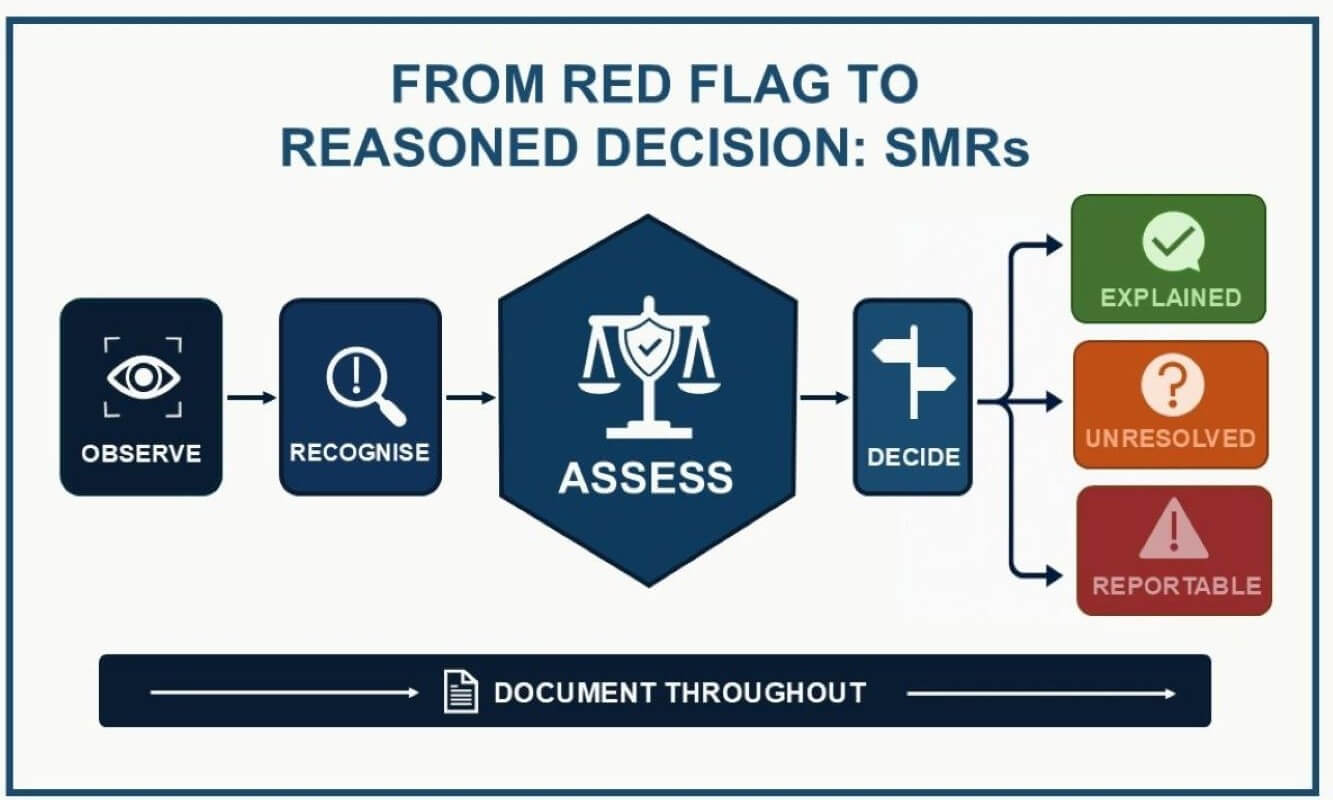
Australia’s AML/CTF regime requires a risk-based assessment.3 This article proposes a practical four-stage framework. It asks four questions:

Observe: What are the objective facts?
Recognise: Why might those facts matter?
Assess: What do they mean in context?
Decide: Has the section 41 threshold been met?
1. Observation – what are the objective facts?
The process ordinarily begins when a practitioner or staff member notices something unusual about the client, another party, the proposed designated service, the source of funds, the transaction, the instructions, or the surrounding circumstances.
For example:
- The client requests an unnecessarily complex ownership structure;
- The source of funds appears inconsistent with what is known about the client;
- An unrelated third party proposes to provide funds;
- There is unexplained urgency or secrecy; or
- The transaction has no apparent legal, commercial, or economic purpose.
At this stage, the practitioner or staff member has observed something unusual; no conclusion has been reached.
2. Recognition – why might those facts matter?
The next step is to consider whether the unusual circumstance corresponds with a recognised money laundering, terrorism financing, or proliferation financing risk indicator.
AUSTRAC identifies indicators involving customer identity, source of funds and wealth, ownership structures, third-party involvement, higher-risk jurisdictions, customer behaviour, and transactions inconsistent with the customer’s known profile.4
Published indicators assist assessment, but they are not a statutory precondition or proof of wrongdoing. Information may require assessment even if it does not appear on a published red-flag list. An overseas source of funds, third-party payment of legal fees or a complex structure may have a legitimate explanation.
The Law Society of New South Wales expresses the distinction succinctly:
“A red flag does not mean that you need to stop or decline the transaction or terminate the retainer. It is a sign to pause and ask further questions or conduct enhanced customer due diligence. It could be that you can satisfy yourself with further questions, but in some cases, there will be a need to submit a suspicious matter report.”5
That guidance reflects the risk-based nature of the AML/CTF regime. A red flag is the beginning of the assessment process, not the end of it.
Red flags are contextual indicators – not a checklist.
One indicator may be satisfactorily explained, while several indicators may arise from the same innocent circumstance. Conversely, a single serious and well-supported indicator – or the cumulative effect of several indicators – may establish reasonable grounds for suspicion when assessed in context.
The existence of a red flag may:
- increase the level of scrutiny applied;
- prompt further enquiries;
- require verification of information or explanations;
- require enhanced customer due diligence;
- justify closer ongoing monitoring; or
- ultimately be satisfactorily explained.
AUSTRAC’s Legal Profession Program Starter Kit reflects this approach. Its documents distinguish between recording unusual client activity, escalating that activity to the AML/CTF compliance officer, and the compliance officer assessing and responding to the escalation.6
The red flag starts the process. It does not predetermine its outcome.
3. Assessment – what do they mean in context?
Assessment bridges the gap between a red flag and an SMR.
The person or team nominated under the practice’s AML/CTF policies should test the concern against all reasonably available information, rather than seek to confirm an initial impression.
Depending on the circumstances, relevant considerations may include:
- What precisely has caused the concern?
- Is the information reliable?
- Is there a legitimate explanation?
- Is the explanation objectively plausible?
- Is it consistent with everything else known about the client?
- Can the explanation be independently verified?
- Is the activity consistent with the client’s known profile, financial position and stated purpose?
- Are there additional indicators?
- Does the activity correspond with a recognised money laundering, terrorism financing, or proliferation financing method?
- What relevant risks are identified in the practice’s ML/TF risk assessment?
- Have further enquiries reduced or heightened the concern?
- Is enhanced customer due diligence required?
The assessment should be disciplined and evidence-based. The statutory test has both subjective and objective elements: the reporting entity must form the relevant suspicion, and there must be reasonable grounds supporting it. AUSTRAC describes those grounds as being assessed by reference to the facts, circumstances and information known – or reasonably expected to have been known – at the time. The task is not to prove criminal activity, conduct a criminal investigation or establish guilt. Equally, the person or team responsible under the AML/CTF policies should not accept an implausible explanation merely because it cannot immediately be disproved.
AUSTRAC’s current guidance describes four steps that the reporting entity’s AML/CTF policies must support:
- identifying suspicious activity;
- conducting a timely review of the relevant material;
- deciding whether reasonable grounds for suspicion exist; and
- submitting an SMR where the threshold is met.7
AUSTRAC illustrates the problem with an SMR that merely states that activity “looked unusual” and that the report was submitted “just in case it might be suspicious”. It explains that such wording does not identify why the activity is considered suspicious or what offending may be involved.8
The assessment will usually produce one of three outcomes.
Outcome 1 – the concern is resolved
- The issue has been satisfactorily explained.
- The available information does not support reasonable grounds for suspicion.
Outcome 2 – the concern remains unresolved
- An unresolved concern is not automatically reportable, but it cannot simply be left unattended. The reporting entity must determine, as soon as practicable, whether it suspects on reasonable grounds one of the conditions identified in section 41 is satisfied. Further proportionate enquiries, or continued monitoring where relevant, may be appropriate, provided the statutory threshold has not already been reached.
- Enhanced customer due diligence may be required.9
Outcome 3 – the statutory threshold is reached
- The reporting entity suspects, on reasonable grounds, one of the matters identified in section 41.
- Subject to the legal professional privilege provision in section 41(2A), any applicable exemption under section 42, or an applicable exemption or modification under section 248 (including under the Anti-Money Laundering and Counter-Terrorism Financing (Class Exemptions and Other Matters) Rules 2007), the reporting entity must give AUSTRAC an SMR within the applicable timeframe.10
4. Decision – has the section 41 threshold been met?
The decisive question is not: “Have I identified a red flag?”
It is: “Does the reporting entity now suspect on reasonable grounds one of the matters identified in section 41 of the AML/CTF Act?” If so, subject to the legal professional privilege provision in section 41(2A) and any applicable exemptions identified under the AML/CTF Act or Rules, the reporting entity must submit an SMR within the applicable timeframe.
Section 41 identifies the circumstances in which a reporting entity must submit an SMR. Those circumstances extend beyond a suspicion that a client is engaged in money laundering or terrorism financing. They include, among other things, certain identity-related concerns and information that may be relevant to the investigation or prosecution of offences or tax evasion. Practitioners should therefore refer to the terms of section 41 itself when assessing whether the statutory threshold has been reached.11
The client or prospective client need not necessarily be the person suspected of offending. Some limbs of section 41 concern information that may be relevant to the investigation or prosecution of another person.
Nor is certainty required. The statutory question is whether there are reasonable grounds for the relevant suspicion – not whether the practitioner can prove that a crime has occurred.
This is not a novel concept confined to the AML/CTF Act. The expression “suspects on reasonable grounds” reflects familiar principles governing statutory tests framed by reference to reasonable grounds. In George v Rockett, the High Court held that where a statute requires reasonable grounds for a state of mind – including suspicion – there must exist facts “sufficient to induce that state of mind in a reasonable person”; a bare assertion, or an unsupported possibility, will not suffice.12
Embedding the framework in the practice’s AML/CTF policies
The distinction between red flags and SMRs should be reflected in the practice’s AML/CTF policies.13
Staff should not be expected to decide conclusively whether an SMR must be submitted whenever they encounter something unusual.
Ordinarily, their role should be to:
- recognise unusual circumstances or potential red flags;
- record the objective facts;
- preserve relevant information and records;
- escalate the concern promptly in accordance with the practice’s AML/CTF policies; and
- avoid improperly alerting the client.
The policies should identify the person or team responsible for:
- receiving internal escalations;
- reviewing the relevant information;
- determining whether enhanced customer due diligence is required;
- assessing whether reasonable grounds for suspicion exist;
- submitting, or arranging the submission of, an SMR where required; and
- documenting the assessment, decision, response and reasons.14
AUSTRAC says the person or team responsible for assessing suspicious activity and submitting SMRs may be the proprietor of a sole-trader business, the AML/CTF compliance officer or a dedicated team in a larger organisation.15
Prompt escalation is essential because, once the reporting entity forms a reportable suspicion, the statutory reporting timeframes begin to run.16
A concise instruction for staff may be:
- Notice it;
- Record the facts;
- Escalate it promptly;
- Do not wait until you are certain.
Applied to the opening scenario:
- Observe: The purchase is being funded from several sources, including the purchaser’s own overseas account;
- Recognise: Overseas and fragmented funding may warrant closer scrutiny. The concern may be greater if the funds originate from a high-risk jurisdiction or a country with which the purchaser has no apparent connection;
- Assess: The account is in the purchaser’s name and there is an intelligible connection with the country. The reporting entity should also consider the jurisdictional risk, the purchaser’s explanation and the remaining sources of funds against the information known about the purchaser; and
- Decide: On the facts given, the overseas transfer does not, by itself, establish reasonable grounds for suspicion. A connection with a high-risk jurisdiction would be an additional factor requiring careful assessment but might not automatically establish the SMR threshold. The reporting entity must reach – and document – its decision after considering all relevant circumstances.
Final thoughts
Red flags are an essential part of Australia’s AML/CTF regime. But they are not conclusions.
The practical framework outlined in this article distinguishes four separate stages of analysis. Practitioners should keep those four stages separate: Observe, Recognise, Assess, Decide.
A red flag tells you to look more closely. It does not, by itself, tell you to lodge an SMR.
This article does not address the separate questions of legal professional privilege, tipping off, the detailed operation of the reporting timeframes or whether the retainer should continue once a reportable suspicion has formed.
Footnotes
1 Anti-Money Laundering and Counter-Terrorism Financing Act 2006 (Cth) (AML/CTF Act) s 41(1)(d)-(j). See also George v Rockett (1990) 170 CLR 104, 112 (Mason CJ, Brennan, Deane, Dawson, Toohey, Gaudron and McHugh JJ).
2 AML/CTF Act s 41(1)(a)–(c).
3 AML/CTF Act ss 26C, 30(1), (2)(a) and (5).
4 AUSTRAC, Risk insights and indicators of suspicious activity for legal professionals (‘Kinds of clients’, ‘Indicators of suspicious clients’, ‘Kinds of services’ and ‘Indicators of suspicious client activities’), Risk insights and indicators of suspicious activity for legal professionals (accessed 6 August 2026); AUSTRAC, Suspicious matter reports (‘Common indicators of suspicious activity’), Suspicious matter reports (accessed 6 August 2026).
5 Law Society of New South Wales, Key obligations for regulated law practices (AML/CTF Hub), available at Key obligations for regulated law practices | The Law Society of NSW (accessed 4 August 2026).
6 Anti-Money Laundering and Counter-Terrorism Financing Rules 2025 (Cth) r 5-12(a)–(b); AUSTRAC, Legal Profession Program Starter Kit: Process document (‘Escalating significant issues’ and ‘Acting on escalations’), available through Legal Profession Program Starter Kit: Document library (accessed 6 August 2026).
7 Anti-Money Laundering and Counter-Terrorism Financing Rules 2025 (Cth) r 5-12(a)–(b); AUSTRAC, ‘Suspicious matter reports’ (‘Steps to follow’), Suspicious matter reports | AUSTRAC (accessed 4 August 2026).
8 AUSTRAC, ‘Suspicious matter reports’ (‘Writing your grounds for suspicion—Ineffective introductory sentence’), Suspicious matter reports | AUSTRAC (accessed 6 August 2026).
9 AML/CTF Act s 32; Anti-Money Laundering and Counter-Terrorism Financing Rules 2025 (Cth) rr 6-20–6-21.
10 AML/CTF Act ss 41(2), 41(2A) and 42.
11 AML/CTF Act s 41(1)(d)-(j).
12 George v Rockett (1990) 170 CLR 104, 112. See also Queensland Bacon Pty Ltd v Rees (1966) 115 CLR 266, 303 (Kitto J), cited with approval in George v Rockett (1990) 170 CLR 104, 115-116 for the distinction between suspicion and belief.
13 AML/CTF Act s 26F(1), (4)(g); Anti-Money Laundering and Counter-Terrorism Financing Rules 2025 (Cth) rr 5-11–5-13.
14 AUSTRAC, ‘Responding to unusual transactions and behaviour’ (‘Step 4—document your review and response’), Responding to unusual transactions and behaviour | AUSTRAC (accessed 6 August 2026).
15 AUSTRAC, ‘Suspicious matter reports’ (‘Steps to follow’), Suspicious matter reports | AUSTRAC (accessed 4 August 2026).
16 AML/CTF Act s 41(2).






Share this article