



The Queensland Law Society appeared at two public hearings yesterday raising some serious concerns in response to the State Government’s proposed changes in the Criminal Code (Dangerous Driving) and Other Legislation Amendment Bill 2026 and the Transport and Other Legislation Amendment Bill 2026.
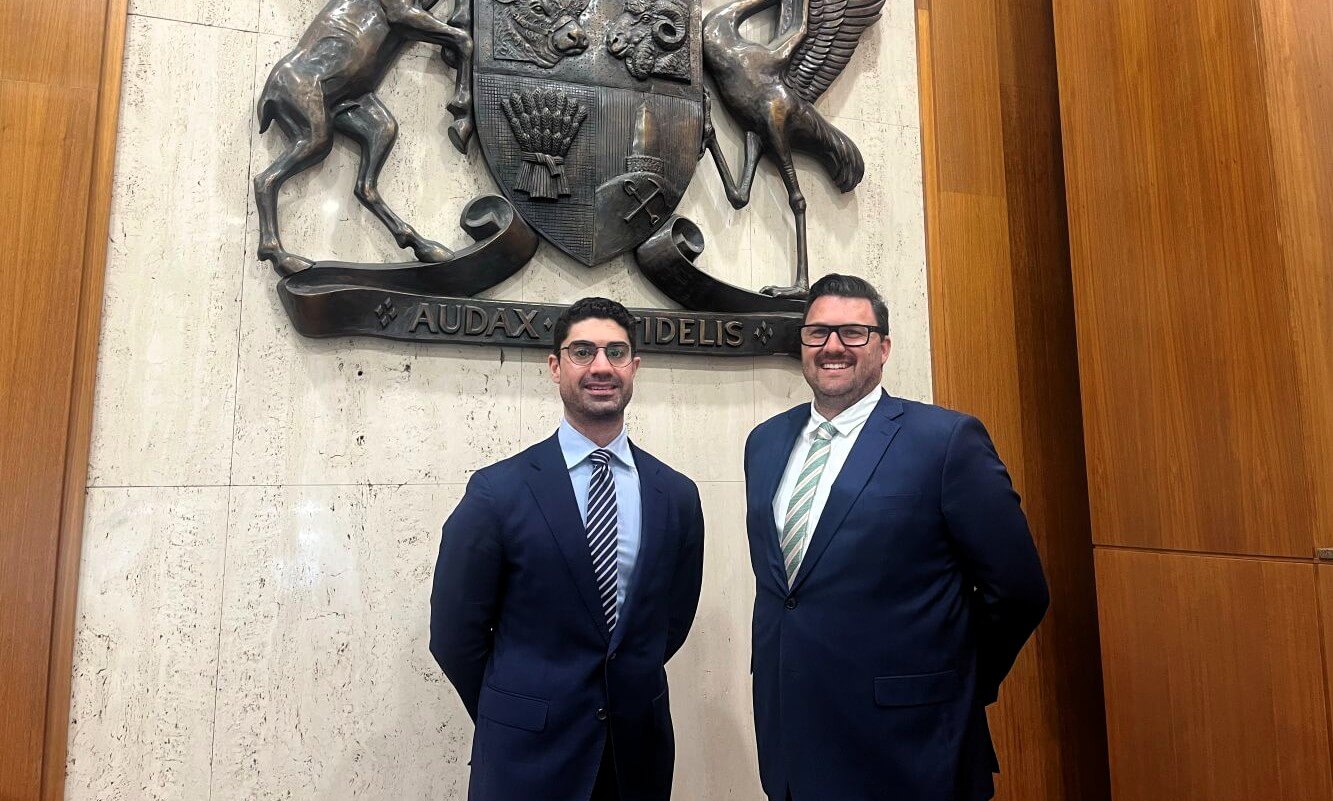
Chair of the Society’s Criminal Law Committee, Patrick Quinn, and Adam Moschella, member of the Criminal Law Committee and accredited specialist in criminal law, represented the Society at both hearings before the State Development, Infrastructure and Works Committee.
At the first hearing regarding proposed changes to the dangerous driving offence framework, Mr Quinn said the Society supported the underlying objective of improving road safety for the community and commended the Government’s focus on this issue.
“However the support for that objective does not extend to support for the amendments through which the Bill seeks to achieve,” he said.
“We identify a number of concerns arising from that restructuring, including the practical impact of the new offence framework, on jury directions and deliberations, and a specific drafting concern regarding the use of the phrase ‘in place’ in the new non-motor vehicle offence.
“We also hold significant concern about the Bill’s removal of the defendant’s existing election to have the new offences heard before a jury. Under the current framework, the defendant charged with dangerous operation of the vehicle has, in defined circumstances, the ability to elect trial by jury in a district court rather than having it dealt with summarily.

“The removal of that election without clear and compelling justification represents a significant narrowing of an accused person’s procedural rights and we respectfully submit that it should be retained.”
The Society’s submission did not support the minimum court-imposed fines for impaired driving offences. In the Society’s view, a mandatory minimum fine removes a magistrate’s discretion to assess the circumstances of each case individually, and to arrive at a penalty that properly reflects all the relevant circumstances in each case.
The submission highlighted that the restructuring of dangerous driving offences could increase the factual and legal complexity of contested criminal proceedings, and by extension the burden placed on juries.
“The new offences in Chapter 29B will require a jury to distinguish between multiple offences, apply a new statutory definition of ‘dangerously’, determine one or more aggravating circumstances, and separately consider causation,” it stated.
“Each of these steps introduces additional technical legal questions upon which a trial judge must accurately and comprehensively direct, and that a jury must correctly apply.”
The Society is concerned the increased complexity would lengthen and complicate summings-up, extend jury deliberation times, and where directions on any one of these composite elements are perceived as inadequate, generate a heightened risk of appeals founded on misdirection.
A further drafting concern highlighted was the use of “at any place” in defining the new offence of operating a non-motor vehicle dangerously.
“The Explanatory Notes state that the new framework separates offending involving motor vehicles from offending involving non-motor vehicles (i.e. bicycles, skateboards) to recognise the particular challenges of road safety and the different risks and culpability associated with conduct involving motor vehicles and non-motor vehicles,” the Society’s submission stated.
“However, on its plain wording, an offence expressed to apply ‘at any place’ is not confined to roads, footpaths or other public places, and may be broad enough to capture conduct occurring in a private setting (for example, children riding bikes or skateboards in their own yard). As such, we recommend the words ’at any place’ are replaced with ‘at a public space’.”
The Bill increases the maximum penalty to 25 years for the new offence involving the dangerous operation of a motor vehicle. The Society does not support an increase in maximum penalty for this offence.
“There are drawbacks to increasing the maximum penalty. The motivation to defend a charge with a higher penalty will be greater and so the charge is more likely to be resisted,” the submission stated.
“We consider alternative legal measures such as consideration of circumstances of aggravation are more appropriate to reflect the detrimental impact of such behaviour at sentencing.”
At the second hearing, the Society’s representatives said it did not support the introduction of minimum court-imposed fines for impaired driving offences.
Mr Quinn said: “We note that, in many respects, the approach reflected in the Bill’s provisions is generally consistent with how the courts already respond to driving-related offending in practice.
“Where the Bill’s provisions align with, and provide clearer legislative footing for the Court’s approach, we see this as a sensible and largely uncontroversial codification.
“Our written submission identifies one specific part of the Bill which we do not support in relation to the minimum court-imposed fines for impaired driving offences.
“In the Society’s view, a mandatory minimum fine removes a Magistrate’s discretion to assess the circumstances of each case individually, and to arrive at a penalty that properly reflects all the relevant circumstances in each case.”
Mr Moschella, in response to a question from the Shadow Minister on Transport and Main Roads Bart Mellish, gave the example of highlighting the differences of the impact and circumstances of a single mother receiving Centrelink paying a $1000 fine to someone worth a million dollars paying the same amount as being quite substantial.
“So having mandatory minimums that really don’t take into account those particular circumstances, it can be quite unfair in terms of the fines that these people will be required to pay,” Mr Moschella said.
“And then also you have the flow-on effect from that – it can then be referred to SPER. As a result of not being able to pay your SPER debt, your licence can then be suspended and there’s consequences for that.
“So it could sort of place people at a disadvantage just on the consequences based solely on their socio-economic circumstances.”
The Society’s submission highlighted “serious concerns about both the underlying rationale for this measure and its practical implications for the fair administration of justice in Queensland”.
“The premise that two people who ‘commit the same offence’ should receive the same fine is incorrect. Two people may commit nominally the same category of offence while being in materially different circumstances.
“One may be a first-time offender in genuine financial hardship with a strong prospect of rehabilitation. Another may be a recidivist offender with no mitigating circumstances. The sentencing process exists precisely to enable courts to distinguish between these cases and impose penalties that are just and appropriate in the specific circumstances of the individual before them.
“In addition, we observe that the proposed provisions governing when and how minimum court fines are to be imposed introduce a level of complexity that appears disproportionate to the problem sought to be addressed.
“Our members’ experience suggests that in circumstances where multiple traffic infringement notices are contested and sent to court, Magistrates will routinely apply the infringement notice amount unless there are special circumstances, and this would therefore also be the approach taken in relation to drink-driving-related infringement notices.”







Share this article