


Australians are better at making wills than many headlines and marketing campaigns might suggest. Research in New South Wales puts will completion in that state at 97 per cent among older adults, one of the highest rates anywhere in the world.
However the same research delivers the uncomfortable second finding: only two to 20 per cent of advance personal planning documents meet high-quality criteria.1
That gap is not a drafting problem. Most practitioners do their best to future-proof the wishes a will contains, and the document that leaves the office is usually a sound one. The problem is what happens next. A will is a static record of a dynamic life, and it starts going out of date the moment it is signed. Relationships form and dissolve. Assets are bought, sold and refinanced. Superannuation moves between funds. Digital accounts multiply, each with a password nobody else holds. The document stays frozen while the life it describes keeps moving.
The cost of that drift lands on the people the will was meant to protect. Executors and families routinely spend hundreds of hours reconstructing an estate: locating accounts, identifying policies, chasing institutions, working out what the deceased actually held.
The Australian Taxation Office currently records around $18.9 billion in lost and unclaimed superannuation across nearly 7.3 million accounts, much of it lost simply because people changed jobs or moved house and no record followed them.
And a will that no longer reflects current circumstances is a will more likely to be contested, with all the financial and relational damage that follows. With an estimated $3.5 trillion set to change hands in Australia over the coming decades, the stakes of an out-of-date record have never been higher.
Nobody owns the upkeep
Every practitioner tells clients to review their will when circumstances change. The advice is right, and it is also where the professional role currently ends. Between the signing and the next event, nobody has the job of keeping the underlying information current.
The client is expected to do it, but the client is untrained, unpaid and unprompted, and behavioural science is clear on how that ends: we defer work whose benefit sits in the future, even when we accept its importance. Reviewing a will is like flossing. Most agree it matters. Fewer do it on schedule.
The result is a system that produces documents efficiently but the maintenance of them is variable or unsystematic across the profession at best. Lawyers see clients at events: a marriage, a divorce, a death, a property purchase. The changes that quietly undermine a will accumulate between those events, invisible to the practitioner until it is too late to fix them.
The shifting value of the estate lawyer
Drafting is automating. Precedent systems, and increasingly AI, are compressing the time and cost of producing the documents themselves. For estate practitioners this is often framed as a threat. It is better understood as a relocation of value.
If the document becomes cheaper to produce, the durable professional contribution moves to the thing no system can automate: knowing the client, noticing when their circumstances have moved away from their documents, and prompting the conversation that brings the two back into line.
That is a maintenance role, and it is one clients will pay for, because it is the role that actually protects their families. The lawyer who knows that a client has sold the investment property named in a specific bequest, or that a nominated executor has moved overseas, or that a new grandchild has arrived, is the lawyer whose next file note prevents a contested estate. The question is how a busy practice gets that visibility without turning every client into a standing agenda item.
Where BillWill fits
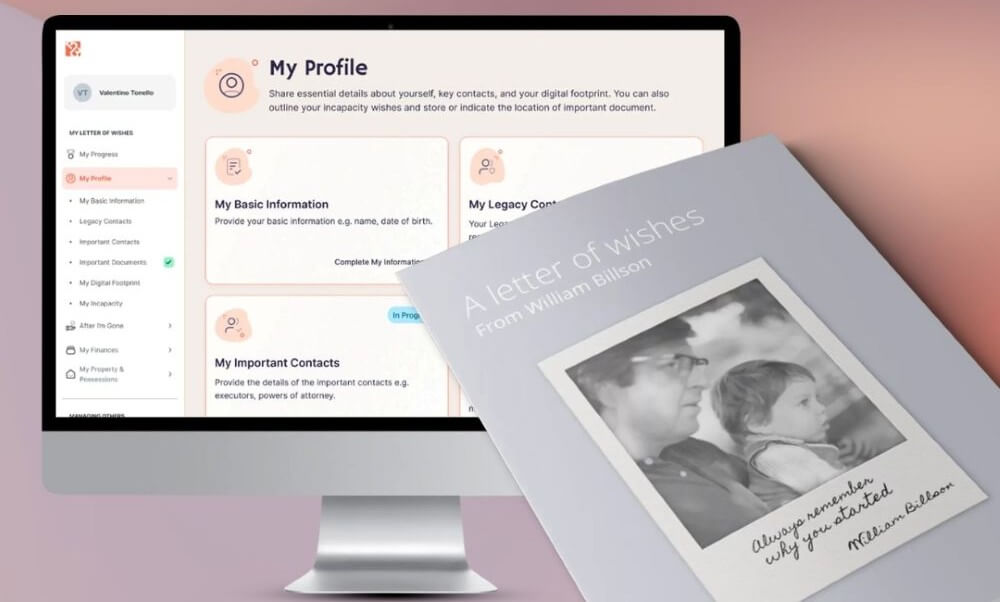
BillWill is Australia’s Living Register and Document Vault, built to provide a map to the information a will cannot: the financial, practical and personal details families need during incapacity or after a death. Clients capture their accounts, assets, policies, digital services and key contacts once, then keep the record current through simple prompts, in minutes rather than meetings.
For the practitioner, the register does two things. It ensures that when the will is eventually relied upon, the executor inherits a current map of the estate rather than a research project. And it creates a live connection between the client’s changing circumstances and the documents that depend on them, so the review conversation happens when a change occurs, not years later at the next event. The will stays a legal instrument prepared by a lawyer. The information beneath it stays maintained.
More than 100 legal and financial advice firms are already on the platform. Firms can white-label BillWill or offer it directly to clients as part of an ongoing estate planning relationship. To see how the Living Register works alongside your existing precedents and review process, visit billwill.com.au or contact us for a walkthrough.
BillWill is a digital platform and does not provide legal advice.
Footnote
1 E Cameron et al, ‘Completed but Incomplete: Prevalence and Quality of Advance Personal Planning among Older Adults in NSW, Australia’ (Manuscript submitted for publication, University of Newcastle & University of Technology Sydney, 2026). Cited with permission.







Share this article