


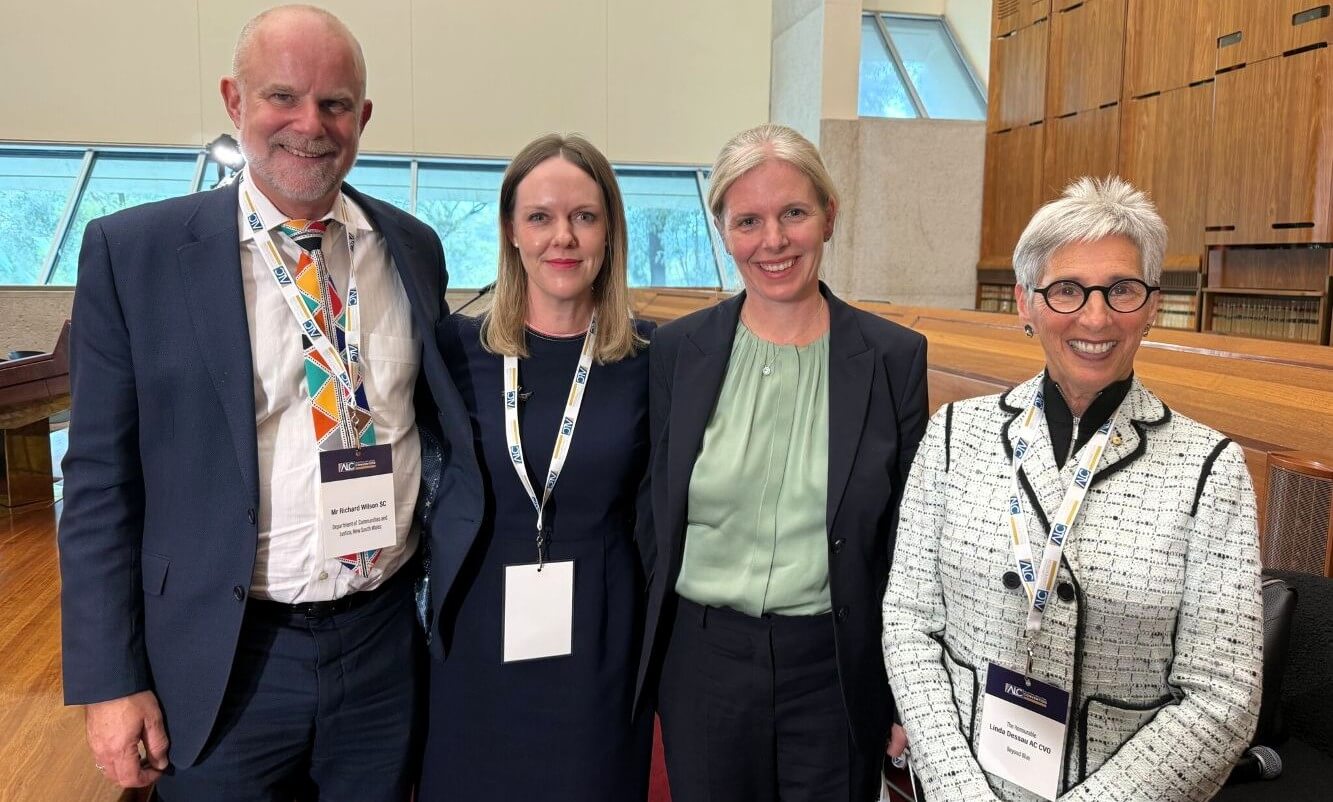
During her Queensland Law Society presidency, Rebecca Fogerty was known for her focus on the profession’s mental health and this month she took that wellbeing message to Canberra.
The QLS Immediate Past President was invited to present at the Australian Legal Convention 2025 at the High Court of Australia on 21 November. The convention brought together a cross-section of organisations within the Australian legal system to engage and explore responses to current and emerging issues.
The convention had seven broad themes including institutional well-being.
When elected in 2024, Rebecca spoke of her passion to explore new ways to enhance wellbeing in the profession and “working with other professions such as medicine and academia so as to develop a mature discourse and meaningful solutions”.
So becoming part of the national dialogue at the convention was another way to contribute to an important conversation and personal goal.
Rebecca told the convention that although there was more to be done, wellbeing was becoming a “priority topic within the Australian legal profession”.

“Discourse around resilience, work-life balance, vicarious trauma and mental health is no longer niche, or confined to specific practice areas,” she said.
“This is partly an overdue correction. For too long, lawyers have been discouraged from outwardly projecting vulnerability, equating it with weakness.
“In such a culture, acknowledging your vulnerability creates risk – professional, social and commercial.
“This is deeply unhealthy. I have seen brilliant colleagues in private turmoil, slowly chewed up by an unhealthy professional culture. I’m sure many of you have.”
So last year Rebecca did something about it on a local level. She was the driving force behind the QLS pilot peer-to-peer support network presentation in May 2024.
The pilot, an Australian first for the profession, was presented online and in person at Brisbane’s Law Society House with more than 300 registrations as senior legal professionals shared their stories.
Panellists shared some, at times, uncomfortable stories of anxiety and physical responses to work situations as well as learnings from mistakes.
Rebecca spoke to the convention audience about the event, and how the solicitors and barristers present spoke about their worst days on the job.
“It was an inspiring sight and a sign of the sea change taking place,” she said.
“But the new focus on wellbeing is not only because of a shift in the culture; it reflects a widespread perception within the profession that we are facing a crisis of poor morale and burnout.
“Law is an intrinsically stressful job. High-stakes decisions, tight deadlines, vicarious trauma, the constant possibility of very public embarrassment. There is also the risk of moral injury.”
Rebecca said these concerns were not new but the themes they identified had only grown over time.
“As lawyers, we look to the past – cases, legislation – to glean solutions for novel factual scenarios,” she said.
“Part of the solution to an improved culture of wellbeing may lie in our ethical rules, which codify (in some cases) thousands of years of wisdom and experience.
“Our ethical rules already embrace many of the values that lawyers need for a professionally nourishing life. This cannot be a coincidence.”
Collegiality was also a theme of Rebecca’s presidency, and she often spoke about treating others with kindness. She touched on this during the convention presentation.
“Take the value of connection,” she said. “Rule four of the Solicitors Conduct Rules expressly codifies a duty of collegiality. Being honest and courteous in all dealings is an extraordinarily good piece of stoic life advice because that is precisely what builds the cooperative relationships, inner restraint and professional growth upon which our wellbeing depends.
“It guards against the corrosive moral impacts of cognitive dissonance and cynicism.
“Lacking pride and purpose can be pernicious in professions like law. But, our ethical rules tell us exactly why we should have pride and purpose. And that is because our individual compliance with our ethical duties connects us profoundly to a shared project of justice.
“Reorienting ethics to a prominent role in our wellbeing discourse is not a magical fix. I do hope it might give heart to some people experiencing disenchantment.
“More powerfully, the ethical dimension also engages institutional obligations to foster a healthy profession, so that the responsibility is embedded and shared, as it should be, by everyone and at every level.”
QLS CEO Matt Dunn said it was an honour for the Society to have Rebecca present at the convention.






Share this article