


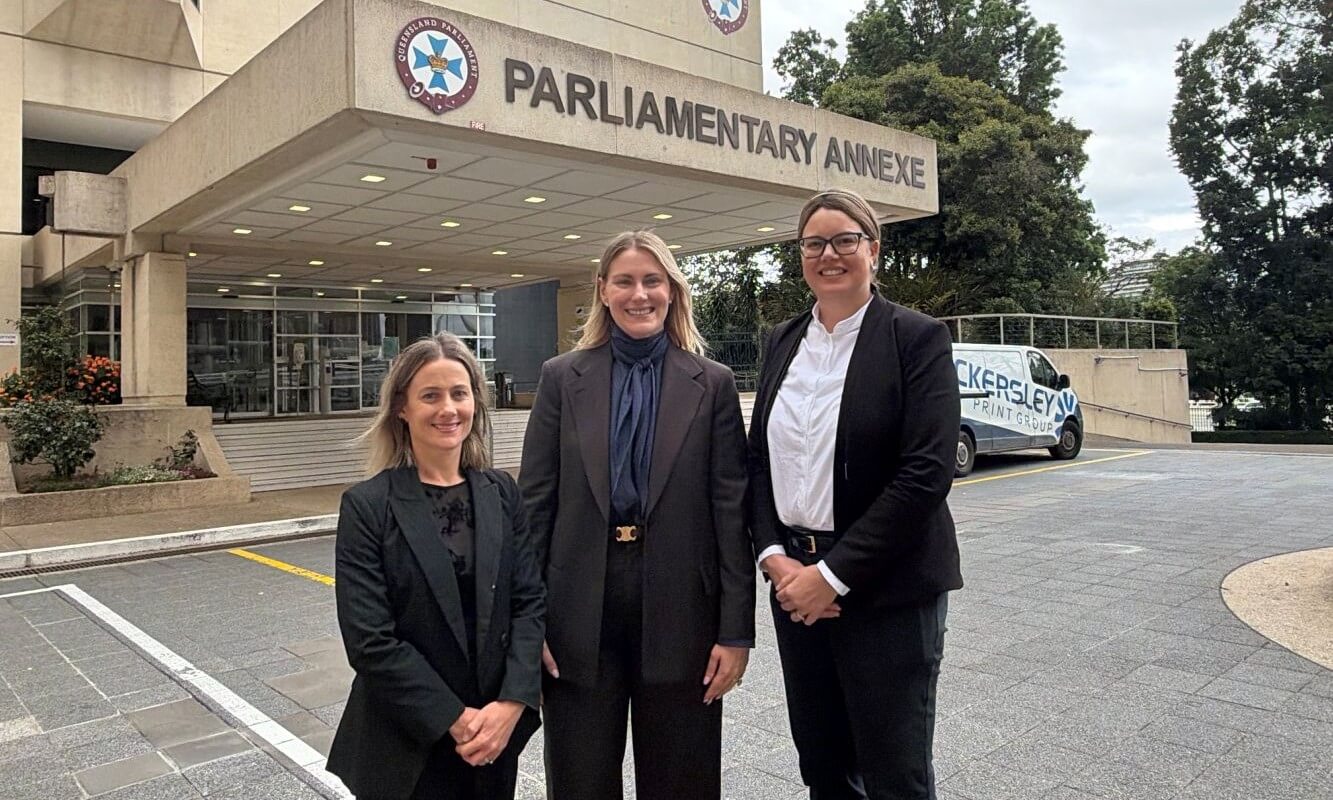
Queensland Law Society representatives presented powerful first-hand evidence of the use of Police Protection Directions (PPD) in domestic and family violence, when they appeared at a public hearing at Parliament House yesterday.
QLS Deputy President Sarah-Jane MacDonald, QLS Domestic and Family Violence Committee member Emily O’Hagan, and QLS Legal Policy Special Counsel Hayley Stubbings shared their insights with the Education, Arts and Communities Committee, at the hearing into the Domestic and Family Violence Protection and Other Legislation Amendment Bill 2026.
The Bill proposes to amend the Domestic and Family Violence Protection Act 2012 (Qld) and other legislation to strengthen justice responses to people using violence, streamline police responses to domestic and family violence and improve the accessibility and safety of court processes for victim-survivors.
Ms MacDonald listed concerns that were raised when the PPD regime was initiated last year by the Domestic and Family Violence Protection and Other Legislation Amendment Act 2025 (Qld).
“Along with many other submitters to this Bill, and indeed to the 2025 Bill that introduced PPDs, we emphasise that while efficiency of policing is a component of improving responses to domestic and family violence in our community, changes that alter the balance between police powers, victim protection, procedural fairness, access to justice and judicial oversight require careful consideration and a strong evidence base,” she said.
“Objections to the introduction of PPDs include concerns about misidentification of the person most in need of protection, apprehension regarding increased breaches as a result of respondents not understanding PPDs or not taking them as seriously as a court order, impacts on matters that intersect with other areas of law such as family law matters, insufficient tailoring of protection for aggrieveds and inappropriate conferral on police of powers impacting an individual’s rights and liberties.”

Various statutory safeguards and a mandated review after two years of operation were said to mitigate against those risks when PPDs were created, she said.
“The current Bill seeks to repeal many of the safeguards without evaluation that would have occurred through that two-year statutory review and without consultation on the proposals.”
Ms MacDonald said the concerns raised by QLS in 2025 were now more acute, given the bid to extend the duration of PPDs to three years and expand the circumstances in which PPDs can be made.
“In examining this bill, QLS submits that the committee should assess whether the proposed amendments will increase the safety of correctly identified victim-survivors of domestic and family violence, how they will impact victim-survivors who are misidentified as perpetrators and how the changes will impact the community’s safety as a whole,” she said.
In response to one of seven questions from the six-member committee, Ms O’Hagan illustrated the Society’s primary concerns if the Bill is passed using the scenario of “Alice”, based on facts from real-life examples.
In the example, Alice, a victim of 10 years of coercive control, physical and sexual violence at the hands of her husband, is misidentified as a perpetrator by police attending an incident.
The police are confronted by a “calm, manipulative abuser” and a “heightened, dysregulated victim”, Ms O’Hagan said, but are incentivised to issue a PPD against one party to avoid having to make a court application if each was issued with a PPD.
As a result, Alice loses her job as a nurse and the PPD is used by her abuser in family law proceedings to alienate her children. Alice sends three text messages in breach of the PPD and is charged with the indictable criminal offence of repeating contravention of a PPD, which carries a maximum penalty of five years’ imprisonment.
“That criminal charge against Alice will be the first time that the parties have come before a court with judicial oversight, and the first time that Alice will have access to independent legal advice,” Ms O’Hagan said.
“Her abuser has done exactly what he told Alice he would do, so our concern is that we’re creating a very serious offence provision which can be triggered by an order taken out by police for an extended period without judicial oversight
“It sounds like an extreme example, but it’s an example taken from real-world experience that both Sarah-Jane and I have had in practising in this area.”
Ms MacDonald appears in Magistrates Courts across the state, is a Legal Aid preferred supplier and an accredited domestic violence duty lawyer, and also appears for private litigants in DV matters.
“I’ve represented clients in court reviews of PPDs under the current regime, and in those matters the core basis has included a failure to recognise where the aggrieved is not supportive of any order or restriction, or the police, in issuing the PPD had not properly considered family exceptions or other exceptions that might be necessary,” she said.
She said a PPD or PPN could be issued as the result of attendance by police at only one event, such as when an emergency call is made for an ambulance.
“The aggrieved in these circumstances often tell me that they call for an ambulance to assist someone, not for a one-year, a three-year or a five-year order to be in place,” she said.
“Issuing a PPD, a PPN, or making an application in these circumstances, often fails to properly account for the complex nature of the relationship which often involves a role of support and caregiving.”
Ms MacDonald said it was the Society’s view that the PPD regime should not be expanded without comprehensive evaluation.
“However, if the Bill is to proceed, QLS recommends that the statutory review provision be amended to ensure that it adequately captures data that would indicate the successes and the unintended consequences of the scheme,” she said.
“In particular, the review should consider issues regarding the rates of review applications, revocations, repeat police protection directions, operation of cross directions, impacts on the vulnerable cohorts including First Nations persons, and evidence regarding misidentification and corrective mechanisms.”
The committee is due to table its report on Friday, 6 November 2026. Regional hearings will also be held.
Read the QLS submission here.






Share this article