




Respected data, technology and intellectual property lawyer Anna Sharpe spoke about two key challenges – compliance and transparency – posed by the rapid changes in cyber security and technology at the recent Best Lawyers Breakfast at Brisbane’s Customs House.
More than 85 guests at the Queensland Law Society event, who were acknowledged for their achievements in the profession, had the chance to hear from the QLS Privacy, Data, Technology and IP Law Committee Chair, who also spoke about the how to harness opportunities appropriately.
Anna, Principal at Sharpe Ivo and consultant to HopgoodGanim, told the audience that in this age of technology “the tiniest details of businesses, and ourselves, is collected, processed, manipulated and shared with ease”.
“The number of cyber incident reports to the Australian Signals Directorate over the five financial years from financial year 2020 has increased by approximately 800 per cent,” she said.
“One key challenge for lawyers is how to stay abreast of, and implement, increasing layers of cybersecurity regulation. Government agencies, the judiciary and professional organisations are working hard to promulgate laws, standards and guidelines aimed at curbing data-related harms.
“Lawyers now need a running compliance playlist of notification and remedial actions responding to data breach incidents affecting themselves and their clients.”


She said guidance notes were available and part of compliance was to become informed about them.
“Queensland Law Society members have the benefit of the work of David Bowles and his colleagues in the cybersecurity space, including standards for accreditation with recognised third-party cyber security experts. The Australian Signals Directorate also has issued guidance and standards for reference.”
Anna said in terms of transparency, there were “real practical difficulties in determining how much transparency about AI and other big data applications is required or should reasonably be expected”.
“Societal and business benefits from AI abound. Many law firms, community legal centres and government legal departments are using, or are actively considering the use, of generative AI as part of their day-to-day processes,” she said.
“Emerging out of the thick fog of information about the good, the bad and the ugly of AI is a simple but profound pointer. It concerns any given use case in any field of endeavour.
“It is that there should be a human in the loop to decide on where it is appropriate to place human decision-making in the design and implementation of the application. One way referring to this is whether to place a human in the AI loop or conversely, AI in the human loop.”
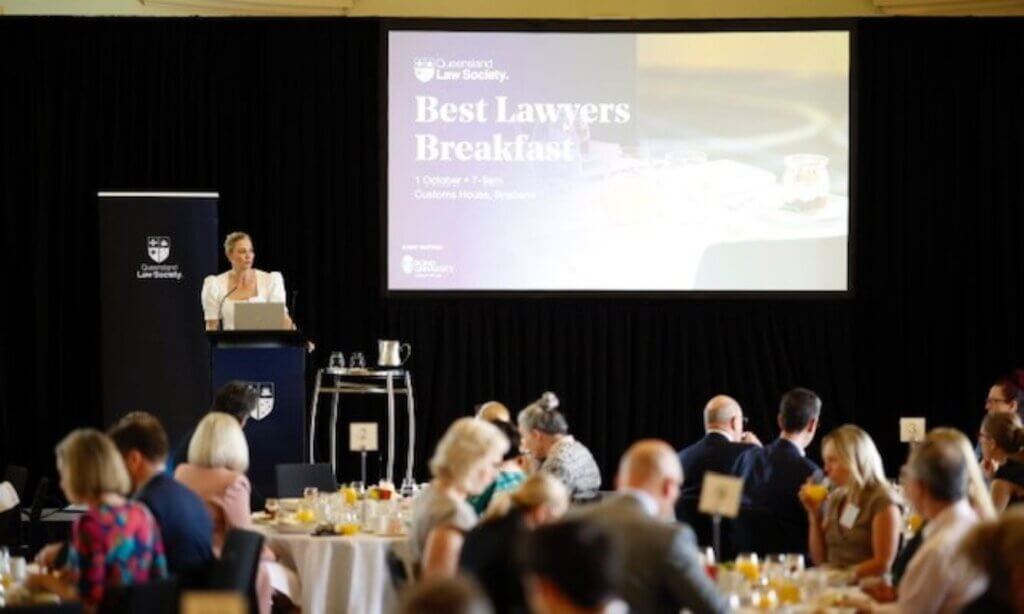
QLS President Genevieve Dee acknowledged those practitioners at the Wednesday morning function, supported by event partner Bond University, who had been recognised in Doyle’s Guide, Best Lawyers, Chambers and Legal 500 Asia-Pacific.
Genevieve said Anna’s speech was a timely topic with QLS committees – including the Privacy, Data, Technology and IP Law Committee and the Cybersecurity and Scam Prevention working group – having contributed to several key state and federal submissions over the past year on developments in privacy, technology, and cybersecurity.
These included submissions regarding children’s privacy, and submissions to the Law Council of Australia to inform its responses to the Productivity Commission’s Interim Report: Harnessing data and digital technology and Horizon 2 of the 2023–2030 Australian Cyber Security Strategy.





Share this article