


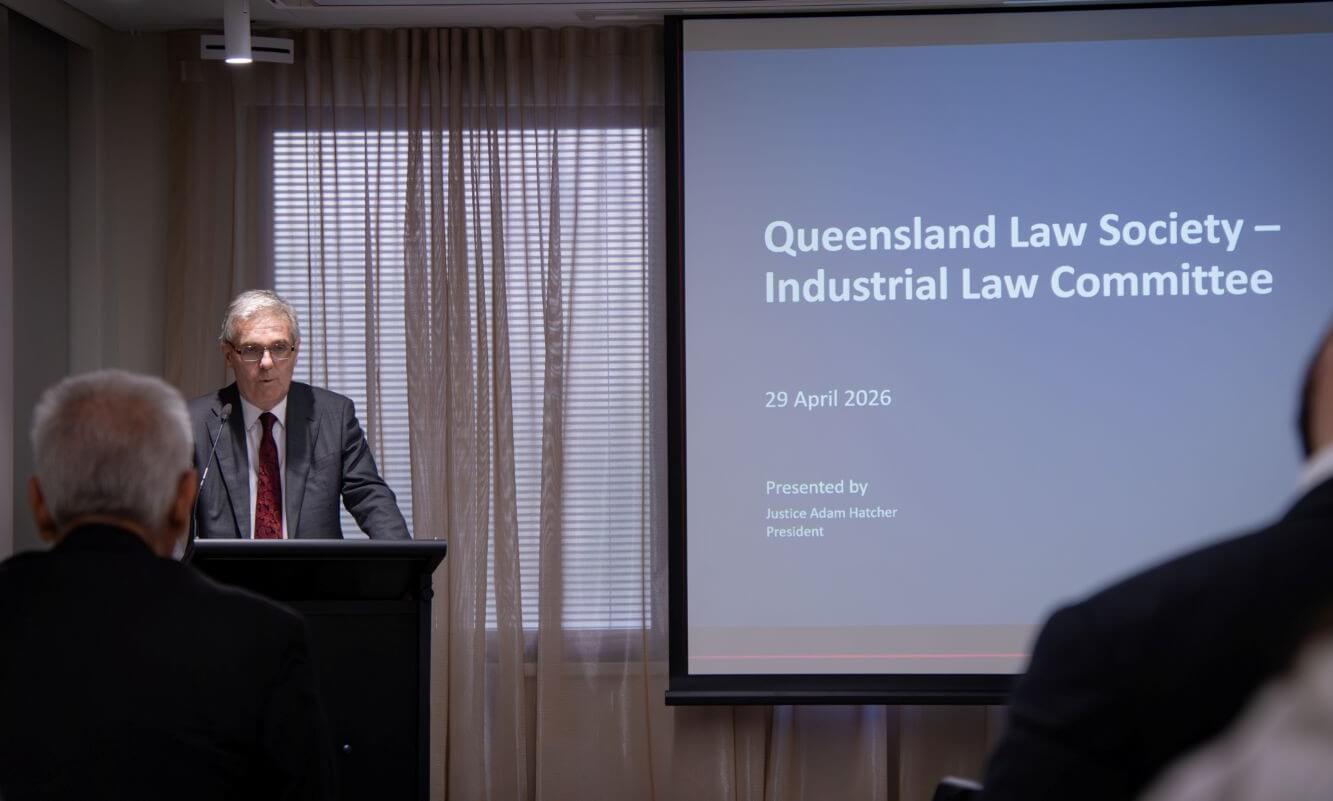
The Fair Work Commission is facing a “perfect storm” with a 75 per cent growth in workload compared to three years ago and a requirement to cut about 11 per cent from its budget, FWC President Justice Adam Hatcher said recently.
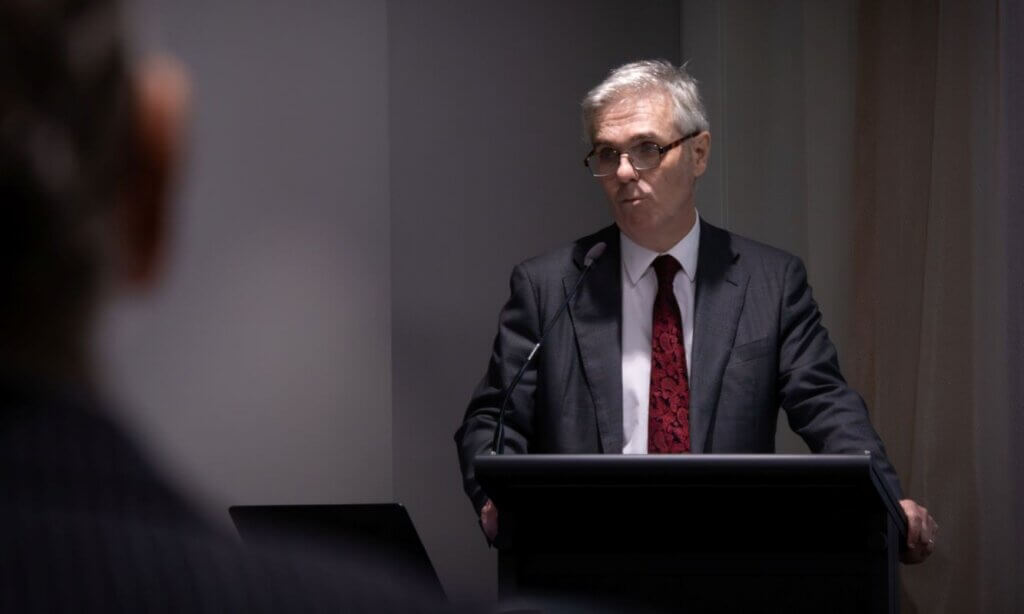
Justice Hatcher spoke to the Queensland Law Society’s Industrial Law Committee on Wednesday about its recent reviews and reforms to address the growing number of applications, which has been severely inflated by artificial intelligence, and its funding challenges.
“I think what’s relevant to you is that if we change the way we go about things and the way we manage cases, this is likely to affect the way in which you experience interacting with the commission in your day-to-day practices,” Justice Hatcher said.
He shared the total number of lodgements in the Fair Work Commission since 2017-21.
“Broadly speaking, the status up until about three years ago was there were about 30,000 to 31,000 total applications a year and it had been that way for some time, except for a bit during the COVID period,” he said.
“But you can see that it then rapidly started flowing. So we went to 40,190, that was a record year.

“Last financial year we went to 44,000, that was another year. And this financial year, I expect it to have about 53,000 to 54,000 applications.
“So you can see that’s a very large increase over a short period of time.
“Perhaps the scary bit about it is that it hasn’t stopped climbing yet, so we don’t actually know what the new normal looks like.”
On investigation, the Commission realised the key event which lined up with the spike in lodgements was the release of ChatGPT.
“So it took a while to work out what was going on, but in fact, the key event in the chronology, which you can more or less line up with that graph is that in November 2022, the first version of ChatGPT is huge.”
In terms of the main case types being handled by the FWC, applications to deal with alleged general protections contraventions involving dismissal have spiked by 62 per cent; general protections contravention disputes up 135 per cent and applications for unfair dismissal remedies have increased by 41 per cent.
“And it’s actually worse than that because the past three-year comparison takes into account two previous record years,” he said.
“If you did it on a long-term basis, it more or less represents a doubling of our workload.
“So when this trend first started, we initially struggled to work out what was causing it. Our first theory was that it was some sort of post-COVID labour market thing that was dragging on too long for that to be the case.
“And the conclusion we’ve reached, which has become increasingly obvious, is that it’s caused by the use by litigants of artificial intelligence to obtain initial advice about what their remedies are, and then to prepare their application to the commission.
“It’s obvious once we know what to look for, we can see the pattern that emerges in applications that come before the commission, and it’s pretty obvious that when you have a worker who’s a blue collar worker and is filing an application on multiple grounds and references to cases of civil defence that they’ve had access to artificial intelligence.
“And what I would invite you to do, just to get an understanding of this, is to do the exercise yourself which is what I did. It’s an eye-opener. If you go to one of the popular generative AI models and just enter in the words, ‘I’ve just been dismissed, what can I do?’
“You can, within the space of 10 minutes, get from that question to a fully developed application, ready for filing in the Fair Work Commission, and another minute will give you a witness statement.
“Now, all it asks you is some very basic facts – who are you, where did you work, why did you think you were dismissed, what did you do, and it invents the whole story out of those few facts.
“It sounds very plausible and realistic, and that’s the application. So, that’s increasing.”

Justice Hatcher said the Commission had conducted research, which would be published soon, into how people prepare their applications for the Fair Work Commission.
“At least about 40 per cent of applicants admit to using AI, and we think the real figure is a bit higher than that,” he said.
Another important and urgent issue impacting the Commission’s work, and a further impetus to review processes, is inadequate funding. Justice Hatcher shared that in 2024/25 funding was about $111 million.
“The government’s now in budget repair mode and is applying across-the-board cuts to all government service agencies, of which we’re regarded as one,” he said.
“So you can see that for this financial year, we have an actual cut in funding of about $2 million, there would be a further cut next financial year and we don’t actually get back to where we were until 2028-29.
“Now of course, our expenses are still increasing like everybody in this room. So you can see that by 27-28, the actual gap between our projected expenditure and our actual funding is about $15 million.
“So in summary, we’ve reached a perfect storm. A 75 per cent growth in our workload compared to three years ago has not stopped growing and a requirement to cut about 11 per cent from our budget to make our expenditure match our revenue.
“So obviously we’ve got to make some fundamental changes to the mode we go about things in order to make all of that work and make sense.”
So the Commission has undertaken a comprehensive reform program, reassessing everything it does, including all major case types but being guided at all stages by access to justice.
“It can’t be something that’s dependent on financial needs, somebody’s expertise, whether they’ve got a disability, the capacity to speak English, or whether they live in Australia,” Justice Hatcher said.
“But at the same time, we have to understand that our resources are finite, and there’s a natural limit to the extent to which we can hear and interpret cases, and this is the most important point of all.
“It is not part of an accessible justice system to facilitate access to the commission’s processes when at the outset these cases are doomed to fail, that is not cases which might not eventually win but the cases which never have realistic prospects of success.
“And to ensure that we have the appropriate resources and time to commit to cases which do have reasonable prospects of success, we have to be more ruthless to people bringing cases which are filed which clearly cannot hope to succeed.
“Because you’ve got to remember that when you have limited resources, every resource you put into a case which is just wasting everyone’s time, is resources which is being taken away from a meritorious case where somebody is seeking a just ruling.”
Justice Hatcher said the reform process would be informed by data and that external stakeholders and the public would be consulted.
A working group has been established and ironically artificial intelligence tools will be used in a number of the Commission’s functions but not decision-making processes.
The process around general protections matters involving dismissals has been reviewed – as a major area of growth in the Commission – and a number of reforms have been implemented after consultation.
The application and response forms have been redesigned to require applicants and responders to more vigorously articulate their case.
“So that requires greater effort, although a cynical person will say that artificial intelligence is up to the challenge of meeting the demands of that new form.”
The Commission is also “taking a rigorous approach to representation at conferences”, which may affect many practitioners.
“That is, we’ve come up with a new model of conducting conferences which doesn’t require people to articulate their cases completely and talk about the outcomes they want, and that means that we’re going to be more strict … at these conferences,” he said.
“The conferences themselves, as I said, have been remodelled. So by virtue of the fact that we need to get to more of these conferences in the day, we need to move away from the traditional set piece mediation model where both parties make an opening statement and this initial exchange about the merits of the case, and actually going to the nuts and bolts trying to work out a settlement.
“What we are now telling parties is that you’ll see this notice before the conference and we’ll hear this from the conference at the very beginning, that we are not engaging in debate about the merits of the case.
“So if you participate at a conference, you can presume that the member or the staff person has read up on the conference, read the file and knows what the case is about and they will be better informed because of the more rigorous forms. And we will simply ask the parties what outcome they want and then ascertain to what extent parties are prepared to make offers of settlement.
“And if at the end of the day, either party makes it clear that they are not interested in settling the matter. The conference will simply end at that point.
“We’re not interested in trying to strong arm anyone into settlement if that’s not the outcome they want.
“So, please, it’s not a good bargaining tactic to pretend that you don’t want to settle as a bluff because you might find 30 seconds later that the conference is over and you’re disconnected from the team’s conference. So we are interested in genuine offers.”
The Commission is also in the process of introducing a new artificial intelligence guidance note with three underlying principles. The draft was published on 24 March for comment – the period for which is now closed.
Justice Hatcher also raised that the Commission had completed a paid agents review with the working group making three recommendations around a code of conduct, a fact sheet about the use of paid agents and a cost disclosure form.
Following Justice Hatcher’s presentation, the Committee heard from Stephen Mackie, Barrister-at-Law, on discrimination claims pursued under the Australian Human Rights Commission Act 1986 (Cth) in relation to costs, and how these claims differ from those under the Fair Work Act 2009 (Cth).







Share this article